Monday, 8 November 2021

A Golden Wave in Egypt’s Vast Ocean of History: The New Kingdom

Iris C. Meijer holds a Master’s Degree in International Law and a deep love for Ancient Egypt in her heart. When her career was cut short by chronic illnesses, she decided to do what she had planned for eventual retirement and moved to Egypt almost 19 years ago. She now lives in Luxor, ruled by 17 rescued Fluffy creatures.

As anyone who has ever dipped even the tiniest toe into the vast waters of Ancient Egyptian history will know, it is an enormous expanse of time that is almost impossible to truly wrap one’s mind around as a phenomenal, single culture. Luckily, the current course of the Egypt Centre, taught with great aplomb by Dr Ken Griffin and moderated with fabulous finesse by Sam Powell, takes on an incredible period of 4700 years (4400 BCE–300 CE; from the Badarian Period to the end of the Graeco-Roman Period) and breaks it down for us into delectable bite-sized piecesbecause even though we tend to speak of Ancient Egyptian history as one block, it is of course nowhere near as straightforward as that. There were fluctuations, changes in culture, adaptations of style and religion, periods of high glory and periods of great struggle and fragmentation, periods of expansion and periods of reduction in size, and so on. And yet, through it all, it remains unmistakably identifiable as Ancient Egyptian, in basic concepts, art, outlook, religion, stratification of society, and more.

The golden ages when Ancient Egypt was united and strong are referred to as the Old, the Middle, and the New Kingdom, while the times in between when the unity fell apart and the control over the country was fragmented are called Intermediate Periodsearlier and later periods go by other names yet. Each period has its own specific traitsand is important to note that all these monikers are modern inventions in an effort to divide up that vast expanse of time into periods that can be handledthe ancients themselves never used these terms. Most Egyptophiles I know have very specific periods that they are particularly drawn to. I certainly do. It was this period of the New kingdom that stole my heart at 10 years old, when I first clapped eyes on its stunningly elegant statuary (fig. 1) at the National Museum of Antiquities in Leiden, the Netherlands, and was shaken to my core and gripped for the rest of my life.


Fig. 1: New Kingdom statues in Leiden
(https://www.world-archaeology.com/features/secrets-of-saqqara/)


The New Kingdom is known as the Age of Empire, a golden age during which through conquest by intrepid kings, Egypt reached the largest borders it ever had. It spans a phenomenal heyday from around 1550–1069 BCE when the might of Egypt could not be denied and stretched from the Levant all the way down into the Sudan. Next to campaigns of war, enormous building projects were undertaken (granted, no pyramids any longer, but I defy anyone to walk through the Temple of Karnak (fig. 2), for instance, and not be overwhelmed by the soaring columns, the impressive pylons, the delicate reliefs, immaculate hieroglyphs, and gorgeous chapels and smaller temples in that precinct, which all taken together is arguably the largest temple complex in the world to this day!), stunning statuary was commissioned, giant tombs were dug in the Valley of the Kings and decorated with all kinds of magical spells to see the pharaohs through the journey of the afterlife, as well as smaller ones close to that sacred place, for the elite full of charming scenes of daily life with ‘lower’ level magic spells to get them to the Field of Reeds, an ancient Egyptian’s view of paradise, and everywhere was the glow of goldjust think about the treasures of Tutankhamun!


Fig. 2: The Great Hypostyle Hall at Karnak


And the history of the New Kingdom! It has everything one could possibly desire in a good fictional yarn even though it is not fiction: strong heroes and heroines, dastardly foes, palace intrigue, heresy, vindication, plots, revenge, exploration of foreign lands, treasure being brought home (fig. 3), treasures stolen, you name it. And the Ancient Egyptians very kindly left us just enough sources to build a narrative, but also just enough holes to leave room for speculation and discussion.

Fig. 3: Seti I presenting tribute to Amun


A case in point is my own favourite king: Hatshepsut (fig. 4), who reigned from about 1479–1458 BCE. Originally not a king but a king’s wife (and half-sister!), when the king died and his heir by another wife was too young to rule, she took over the reins of the country as his regent. This all went very well for a few years, but then, in an unprecedented move and with the rightful king still alive and doing well, she decided to declare herself king as well! Egypt was a very patriarchal land, so this was a move that must have been shocking to many but she did itand ruled for about 20 very prosperous and peaceful years as the true king, even taking on male form and the full five-fold titulary of a proper pharaoh on her monuments. She even claimed to be a direct daughter of the supreme god of the time, Amun-Ra, who in the guise of her father had sown the seed for her in her mother, thus marking herself as his chosen one. She did quite often also depict the younger pharaoh (who later became Thutmose III), but always in a position behind herself, sending a clear message as to who was really in charge: she herself, King Ma’atkare (her throne name).

Fig. 4: Hatshepsut "stretching the cord" with Seshat

After the end of her reign, Thutmose III (fig. 5) took over seamlessly and just incorporated her years of rule to his ownhe had still also been king during that time, after all. But what to do with such a predecessor, what to do with her ascendancy that might give other female royals ideas beyond their station? Her memory must be obliterated, of course. And so it was done, she was erased from history for Ancient Egyptian civilisation. But here something interesting happens, which also shows that history is always a matter of new discoveries and of interpretation, coloured by the ‘glasses’ of the times that are regarding that long-ago time now.


Fig. 5: Statue of Thutmose III


With the modern rediscovery of ancient Egypt, slowly, slowly her story, monuments and art did come to light again in the nineteenth century CE. The erasure had not been completeit could be pieced together again (fig. 6). As clues to her story began to emerge, the belief was at first that Thutmose III must have hated his aunt for stealing his throne, and in revenge chiselled out all her representations and names. However, it later came to light that this erasure did not happen until the end of his own very long solo rule. How could he have curtailed his hate so long? Why should he? More thought led to the current belief that this damnatio memoriae probably only started after Thutmose III had appointed his chosen successor, later to become Amenhotep II, as co-regent, and it was quite likely that it was he, not Thutmose III, who ordered the memory of Hatshepsut removed (luckily rather unsuccessfully in the end). It is very probable that Thutmose III and Hatshepsut had rubbed along quite happily togethershe taking care of the tiresome business of actually ruling, whilst he was honing his skills off with the army to later become the greatest general of Egypt (sometimes dubbed “the Napoleon of Ancient Egypt” by later historians). We do not know this for truth, of course, as the intricacies of their mutual relationship was never commented on as suchno paparazzi in those ages! We also do not know exactly why the later Amenhotep II (we think) all of a sudden tried to erase her from history, decades after the end of her reign. Remember those holes that leave room for delicious speculation and delightful discussion that I mentioned earlier? Well, this is definitely one of them! A tale that many books can and have been written aboutscholarly ones as well as novels, with the holes filled in with whatever version the author thought most likely. Juicy, right? And that is just one example of one reign (or two intertwined ones, actually) inside one dynasty (the Eighteenth) of the fascinating 500 years or so of the New Kingdom.

Fig. 6: Erased image of Hatshepsut at Karnak

I’ve already remarked on the enormous expanse of history that Dr Ken Griffin is audaciously taking on in this fantastic 10-week course. I should also mention that each session is only half pure history. The other half is illustrating that history through objects of the Swansea Egypt Centre’s lovely collection. This is a special treat as thanks to Zoom, those of us who may not have the chance to visit that charming museum in real life, get to peek inside its collection with fascinating objects that each have their own intriguing history. One of the most beautiful objects (but I am biased, as I love Eighteenth Dynasty art above all other Ancient Egyptian art) is comprised of a beautiful fragment of relief, most likely depicting Neferure, Hatshepsut’s only daughter (fig. 7). This relief has a tale of its own that shows that studying Ancient Egypt is still a treasure hunt, a search through even the most minute of clues to find the truth of an object, a period in history, an occurrence, a belief, a link to that a-ha moment. It is, and will remain, endlessly intriguing. For the story of this relief, see this wonderful 30-minute lecture by Dr Ken Griffin on how an object he himself had never seen before, through a handling session of object-centred learning, suddenly changed from a possibly Eleventh Dynasty piece that no one knew anything about, to a revelatory piece of this amazing part of Eighteenth Dynasty history: The Princess Who Never Became King: https://www.youtube.com/watch?v=xYhm1C6AX4c.

Fig. 7: Relief depicting Neferure


Monday, 1 November 2021

The Cast of a Relief of Nubkheperre Intef VI from Coptos

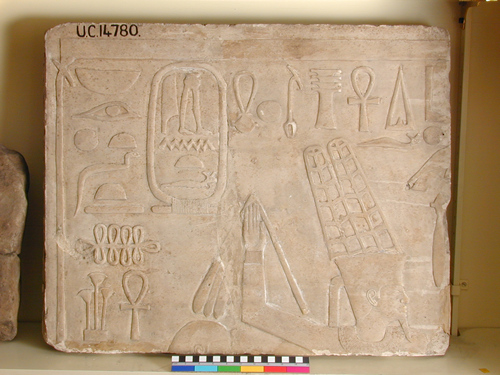
This past week, the course on the History of Ancient Egypt through the Egypt Centre Collection moved on to the Second Intermediate Period. For the blog post this week, I would like to present the cast of a relief (fig. 1) depicting Nubkheperre Intef VI, the original of which is now on display in the Petrie Museum in London (UC14780). Nubkheperre Intef was a Theban king during the Seventeenth Dynasty, when Egypt was largely ruled by the Hyksos. Intef is one of the better-known kings of the Seventeenth Dynasty. His tomb was originally entered by tomb robbers in 1827 when some of its treasures made it into the hands of Western collectors; his unique rishi style coffin was purchased by the British Museum from the Henry Salt collection (BM EA 6652). His tomb was later found by early Egyptologists around 1881 but knowledge of its location was lost again until it was rediscovered in 2001 by Daniel Polz and his team. The tomb, located at Dra' Abu el-Naga', was originally covered with a small pyramid (approximately 11 m at the base, rising to a height of approximately 13 m).

Fig. 1: Front face of EC642


Nubkheperre Intef is known from several monuments, including blocks from a chapel at Coptos. These were excavated by Flinders Petrie in 1894. The blocks, in both raised and sunk relief, can now be found in the Petrie Museum, Manchester, Berlin, Ashmolean, and Philadelphia. EC642 in the Egypt Centre is a cast of UC14780, which is a small block carved in high-quality raised relief. It depicts the upper half of the god Min facing to the right, with traces of the head of Intef directly behind him. This block, along with the others dating to the reign of Intef, were found face down and reused as a pavement of a later addition to the temple at Coptos. The cast in Swansea was produced soon after the relief was discovered, as is evident by the note attached to the reverse of the object (fig. 2).

Fig. 2: Back of EC642


The note reads: “The original of this slab was found at Koptos (the modern Keft of Koft) the present place on the site to the Red Sea by the old trade route, by Professor Petrie in the spring of 1894. The original slab was in a very perfect state as far as the characters go and was found bedded face down forming one of the foundation courses of a more recent temple. The cartouche is that of Antef V of the eleventh dynasty. Nov. 27. 1894. Given to me by James Butler Esqr Blyth House, Humber Road, Blackheath a.c(?)”. James William Butler was elected to the Royal Society of Arts in 1904. Butler seems to have been an inventor, with a Google search bringing to light several patents. For example, in 1886 he patented (patent 352,504) apparatus for moulding perforated blocks for containing electric wires (fig. 3).

Fig.3: Butler's patent


What I have been unable to find is the connection between Butler and Petrie. It is also unclear who wrote the note on the back of the cast in the Egypt Centre. Additionally, how was the object obtained by the Wellcome Historical Medical Museum and when? Like so many objects in the collection, there are a lot of unanswered questions. EC642 is currently on display in the Fakes, Forgeries, and Replicas at the Egypt Centre.

Monday, 25 October 2021

The Middle Kingdom: A Time of Plenty

The blog post for this week has been written by Egypt Centre volunteer Sam Powell, who has been expertly moderating the museum’s online courses during the COVID-19 Pandemic. Sam is a former student at Swansea University and has recently started her PhD research at the University of Birmingham on the topic of wooden funerary figures.


This week as part of the History of Ancient Egypt through the Egypt Centre Collection course, we covered the Middle Kingdom (2000–1750 BCE). Wooden funerary figures are a common occurrence in elite tomb contexts from the end of the Old Kingdom through the Middle Kingdom. As is often the case with collections, the provenance of the wooden funerary figures held by the Egypt Centre are not recorded, and so can only have tentative dating assigned based on their stylistic features. During my research for my Masters dissertation, I tentatively assigned thirty-nine (over half of the corpus of wooden funerary figures held by the Egypt Centre) to the Middle Kingdom. From the reunification of Egypt during the reign of Nebhepetre Montuhotep II in the Eleventh Dynasty, and into the Twelfth Dynasty in particular, the production of wooden tomb models and funerary figures becomes widespread. This, however, in many cases leads to a reduction in the quality of production. 

As a small update to the work on the wooden funerary figures, over the summer Ken (in person), and I (virtually) rearranged the figures on display in the House of Death gallery to incorporate the figures returning from conservation at Cardiff University (fig. 1). The figures are now grouped by the activities being carried out. The reuniting of the figures with their missing limbs makes a massive difference to their interpretation.


Fig. 1: Redisplay of the wooden tomb figures


There are several well-known examples of funerary figures, of particular note, those known from the Theban tomb of Meketre, dating to the early Middle Kingdom (fig. 2). A wide range of scenes occur as tomb models by the Middle Kingdom, representing not just scenes of food production, but also manufacture, model boats, model gardens, and military scenes amongst others. The models of a likely Middle Kingdom origin within the Egypt Centre collection are all isolated from their models, and so only likely activities and provenance can be suggested on stylistic grounds. When considering this corpus, the traits of figures are the easiest to identify.


Fig. 2: Offering bearer from the tomb of Meketre (MMA 20.3.7)

W687

W687 is a standing figure, likely male, carved from a single piece of wood with peg legs and arms, without the hands and feet defined, and with painted red-brown skin. The hair is a flared cheek-length style, with large eyes in comparison to the size of the face (fig. 3). The legs would have attached to the base by being pegged in and secured with gesso. The shape of the torso, notably the flattened back and pronounced buttocks are commonly seen on models from Beni Hasan dating to the Middle Kingdom. On examination of the object, “380” is written on the reverse of the figure faintly in pencil. This is the tomb number, and matches the handwriting of similar examples from Garstang’s excavations at Beni Hasan. After comparison with Garstang’s excavation reports, this burial did indeed include funerary models from both a boat and a brewing model. Through comparison to contemporary models, it seems most probably W687 is from a brewing model due to the positioning of the arms, but this cannot be determined with any certainty.


Fig. 3: W687

W665, W670, W676, W689, and W692

Five figures in particular (W665, W670, W676, W689, and W692) display the red painted skin, crude style, and are depicted with flat-bottomed wigs and fitted kilts (fig. 4). The legs are wider at the top, narrowing to the “peg” terminals, which would have been the method of attachment to a model in the case of the three striding figures, and with a dowel in the seat of the two seated figures. The severity of damage and paint loss is similar on all of the figures. These stylistic characteristics fit within the typology as originating from Beni Hasan in the early Middle Kingdom, most likely as the crew of a model boat. This can be supported by comparison to examples from Beni Hasan tombs 203 (known from excavation reports, current location unknown) and 394 (Ashmolean Museum, Oxford AMO 1896-1908 E.1991). These examples both date to between the Eleventh and Twelfth Dynasties. Further supporting evidence arising from the auction details is the name of the previous collector prior to the sale. In this example, the material purchased by Wellcome in 1928, from the collection of Charles James Tabor (1849–1928), but had previously been part of the collection of Rev. William MacGregor (1848–1937), sold at auction in 1922 to Tabor. It is clear that MacGregor contributed to Garstang’s excavations at Beni Hasan between 1902 and 1904, and as such received material from the site in return for his “donation”. Whilst this cannot conclusively prove the origins of the figures in question, it can be seen as supporting evidence towards this likely provenance; the combination of the application of a stylistic typology, comparison to known examples, and the consideration of the figure’s more recent history can all be vital clues when dealing with material of this type.


Fig. 4: Five wooden figures

Bibliography:

Garstang, J. (1907). The burial customs of ancient Egypt as illustrated by the tombs of the Middle Kingdom. 1902–4. Edinburgh: Archibald Constable.

Sotheby, Wilkinson & Hodge (1922). Catalogue of the MacGregor collection of Egyptian antiquities. London: Davy.

Tooley, A. M. J. (1989). Middle Kingdom burial customs. A study of wooden models and related materials. Unpublished thesis (PhD), University of Liverpool.

Winlock, H. E. (1955). Models of Daily Life in Ancient Egypt from the Tomb of Meket–Rê at Thebes, Metropolitan Museum of Art Egyptian Expedition 18, Cambridge, Massachusetts: Harvard University Press.

Monday, 18 October 2021

A History of the First Intermediate Period

The blog post for this week is written by Jeanne Whitehurst, who has completed her Certificate of Egyptology from the University of Manchester. She moved to Egypt over ten years ago, just before the revolution. Initially, she lived in Luxor, overlooking Karnak Temple, but now she lives in Aswan overlooking the First Cataract. She was extremely fortunate to have worked with Ted Brock on the sarcophagus of Merenptah (KV 8) as a volunteer.

The nineteenth century Egyptologists, not the Ancient Egyptians, gave the name to Intermediate periods which they defined as eras of political strife or instability, whereas stable eras are referred to as “Kingdoms” e.g., Old, Middle, New etc. The First Intermediate Period has long been labelled a “dark age” but was it and if so, what were the causes for the Old Kingdom collapse (fig. 1)? It possibly fell due to problems with succession from the Sixth Dynasty, in addition to the rising power of provincial monarchs. Alternatively, the drier climate that resulted in widespread famine across North and East Africa around 2200 BC. Hieroglyphs record that many people died of famine during this time, which probably caused the period of chaos that followed. Tales were told of people resorting to eating their children and other atrocities. The Egyptian sage Ipuwer gives a graphic description of the horrendous events of that time: “Lo, the desert claims the land, towns are ravaged. Upper Egypt became a wasteland. Lo, everyone’s hair [has fallen out]. Lo, great and small say, ‘I wish I were dead’. Lo, children of nobles are dashed against walls. Infants are put on high ground. Food is lacking. Wearers of fine linen are beaten with [sticks]. Ladies suffer like maidservants. Lo, those who were entombed are cast on high grounds. Men stir up strife unopposed. Groaning is throughout the land, mingled with laments. See now the land is deprived of kingship. What the pyramid hid is empty. The people are diminished.


Fig. 1: Stela of Hetepwt


The Seventh Dynasty marked the beginning of the First Intermediate Period because of internal strife, with the reigns of this and the succeeding Eighth Dynasty being rather obscure. It is clear, however, that both ruled from Memphis and lasted a total of only about 20 years (2150–2130), or as Manetho remarked, “There were 70 Kings in 70 days”. The king list at Abydos mentions sixteen rulers between the Old Kingdom and the reign of Montuhotep II (fig. 2). By this time the powerful nomarchs were effectively controlling their districts, and factions in the south and north vied for power. Many rulers have the name Neferkare, the throne name of Pepi II. We have evidence of a Kakaure from a small pyramid at Saqqara, while Neferkahor and Wadjkare are mentioned on the famous “Coptos decree” stating their funerary monuments were exempt from taxes due to being rulers!

Fig. 2: First Intermediate Period rulers on the Abydos king list


After the obscure reigns of the Seventh and Eighth Dynasty kings, a group of rulers rose out of Heracleopolis, 15km (9 miles) west of the modern city of Beni Suef, and 110 km (68 miles) south of Cairo. They ruled for approximately 94 years. Under the Heracleopolitan Ninth and Tenth dynasties, the nomarchs near Heracleopolis controlled their area and extended their power north to Memphis (and even into the delta) and south to Lycopolis (modern-day Asyut). In total, there were about nineteen rulers. The founder of the Ninth Dynasty, Wahkare Khety I, is often described as an evil and violent ruler who caused much harm to the inhabitants of Egypt, and, as legend would have it, was eventually killed by a crocodile. Khety I was succeeded by Khety II, also known as Meryibre, whose reign was essentially peaceful but experienced problems in the Nile Delta. His successor, Khety III, brought some degree of order to the Delta, although the power and influence of these Ninth and Tenth Dynasty kings were still insignificant compared to that of the Old Kingdom kings.

The rival southern nomarchs at Thebes established the Eleventh Dynasty controlling the area from Abydos to Elephantine, near Syene (present-day Aswan) The Theban kings are believed to have been descendants of Intef or Inyotef, the nomarch of Thebes, often called the “Keeper of the Door of the South”. He is credited with organizing Upper Egypt into an independent ruling body in the south, although he himself did not appear to have tried to claim the title of king. Intef II began the Theban assault on northern Egypt, and his successor, Intef III, completed the attack and moved into Middle Egypt against the Heracleopolitan kings. The first three kings of the Eleventh Dynasty (all named Intef) were, therefore, also the last three kings of the First Intermediate Period. They were succeeded by a line of kings who were all called Montuhotep. Montuhotep II (fig. 3), also known as Nebhepetra, who would eventually defeat the Heracleopolitan kings around 2033 BC and unify the country to bring Egypt into the Middle Kingdom.

Fig. 3: Memorial Temple of Montuhotep II at Deir el-Bahari


Another claim about the chaos of this era is the artwork, the argument rests on the interpretation that it was of poor quality in addition to an absence of monumental building projects. In fact, the opposite is true, it was a time of cultural change, the quality of the artwork may have resulted from a lack of strong central government and an absence of state-mandated art, but an explanation could be that different districts were now free to develop and create their own vision in the arts (fig. 4). The lack of monumental building was probably because the dynasties of the Old Kingdom had drained the government treasury in creating their own grand monuments such as the pyramids of Giza, so, by the time of the 7th Dynasty, there were no resources left for such projects.


Fig. 4: A "soldier stela", which was perhaps reflected the political reality of the period


The First Intermediate period saw the rise of mass-produced crafts for tomb goods. Amulets, coffins, and tomb models were among these crafts which were buried with the deceased. Tomb models (fig. 5), which were thought to come to life and attend to the tomb owners’ needs, were made of faience, stone, or wood. The elongated figures of the period have a charm of their own and required expertise in their carving. Previously, only high officials could afford tomb models but, in this era, they were available to those of less modest means.


Fig. 5: Tomb figures such as this were common during the period


Tombs of the First Intermediate Period vary in standard, but other periods do as well. An outstanding example is the beautifully decorated tomb of Ankhtifi at Mo’alla, 45km south of Luxor on the East side of the Nile (fig. 6). He was a provincial governor and military leader who exercised the power in the south of Upper Egypt under the Ninth Herakleopolitan Dynasty (around 2100 BC). He boasts about his position as the nomarch of the third Upper Egyptian nome and the measures, both peaceful and militarily, he undertook to expand his power base and aid nearby nomes.


Fig. 6: Decoration in the tomb of Ankhtifi


Three inscribed rock-cut tombs at Asyut are a main source of information for the history of the First Intermediate Period. They are historically important because they contain the autobiographical texts of Iti-ibi and Khety (tombs III and IV) that report the great struggle of the Siutian (Asyut) and Herakleopolitan troops against the Theban troops. Asyut, the ancient capital of the thirteenth Upper Egyptian nome, had great strategic importance both by water and by land, and this may well have been why it was so hotly contested.

A time of hardship, temples and tombs were pillaged, Nomarchs trying to control more land, but a time not to be overlooked when Egypt was dynamic and changing its perceptions to welcome a new age which would become the Middle Kingdom.

Monday, 11 October 2021

Decoding the Mastabas of the Old Kingdom

This blog post has been written by Sandra Ottens, who has been working as a secretary at the municipality of Amsterdam for thirty years. Sandra studied Egyptology at Leiden University (BA and MA) from 2006 to 2012. She started blogging about her Egyptological adventures when her class attended a two-month study semester in Cairo, visiting a large number of excavation sites (https://egyptoblogie.wordpress.com). Sandra joined the excavations in Amheida (Dakhla Oasis) as an assistant epigrapher to Professor Olaf Kaper for one season in 2012. She wrote her MA thesis on the Seven Hathors, a group of seven goddesses who predicted the fate of new-born children.

This week in the Egypt Centre’s History course, Ken Griffin discussed the history of the Old Kingdom with its many pyramids and sun temples. The highest officials in the government administration were buried in rectangular mastabas in the tomb fields around the pyramids of their pharaohs, near the capital city of Memphis (fig. 1). While the tomb owners themselves were buried in underground shafts, they also built a chapel above ground where offerings to the deceased could be made. These chapels were richly decorated with elaborate scenes from the ideal elite existence in the expectation of prolonging it in the afterlife. The scenes are often accompanied by texts. There are captions to clarify what is happening, words that are spoken by the people depicted, and even the lyrics of work songs sung by those employed to help keep a steady rhythm during strenuous repetitive work.


Fig. 1: Schematic drawing of an Old Kingdom mastaba


The decorated chapel walls contain a lot of interesting and original details and can be read almost like comic books. Note for instance what is happening in figure 2 from the tomb of princess Idut. The Leiden Mastaba Project was initiated in 1998 to build a database of iconography in Old Kingdom elite tombs from the Memphite area. The project, directed by Dr. René van Walsem from Leiden University, resulted in the original MastaBase on cd-rom in 2008 (published by Peeters in Leuven). It has since proven to be an indispensable research tool. In 2014, a group of enthusiastic Egyptologists from Leiden joined Dr. René van Walsem in forming the Leiden Mastaba Study Group, to work on an enhanced and updated version of the database. The first step in the project was making the basic dataset accessible online, to be consulted free of charge by researchers, students and interested people around the world. This basic data set can be found on https://digitalegyptology.org/mastabase/While a lack of funds has made further development of the database an unfulfilled dream for now, the members of the study group have occupied themselves with reading some of the texts from the Mastabase.

Fig. 2: Decoration from the tomb of Idut


Our current subject is ‘observation texts’. Most mastabas contain one or more large images of the tomb owner looking out over the activities that are depicted on the wall before him or her. That image is usually accompanied by an ‘observation text’, which describes what he or she is looking at, starting with the verb mꜣꜣ (observing). I will give an example from the mastaba chapel of Hetepherakhty (currently in the Rijksmuseum van Oudheden (RMO) in Leiden). You can get virtual access to the chapel (on the ground floor of the museum) via this link: https://artsandculture.google.com/partner/rijksmuseum-van-oudheden. Hetepherakhty (fig. 3) had his tomb built in Saqqara during the late Fifth Dynasty, possibly around the same time as Tjenti, whose lintel is in the Egypt Centre collection (W491).


Fig. 3: Tomb of Hetepherakhty


Inside the chapel on the left (south) wall, Hetepherakhty is shown standing with a long stick in his hand (fig. 4). Above him, the text gives his name and titles: ‘Eldest of the Hall, priest of Ma’at, Hetepherakhty’. Behind him at ground level, a servant is holding a rectangular parasol above his head to shield him from the sunlight. Behind the servant is a boy described as a ‘follower’, carrying something over his shoulder. Depicted above the boy is the eldest son of the tomb owner, the judge and scribe Nyankhptah.


Fig. 4: Relief from the tomb of Hetepherakhty


The text we are focusing on in our reading group, however, is the column of hieroglyphs in front of Hetepherakhty: ‘Observing sowing, harvesting of flax, and mowing of wheat’. Indeed, part of the wall that stretches out before him contains images of the described activities, and most of the hieroglyphs used in the ‘observation text’ are repeated to clarify the images (fig. 5). Thousands of years after they were made, they are also used to teach Egyptologists the vocabulary that the Egyptians used for their activities.


Fig. 5: Relief from the tomb of Hetepherakhty


At the top left of this image stands a scribe, with some pens behind his right ear and a roll of papyrus under his left arm. Next to him two men are working a plough, drawn by a pair of cows. The text confirms they are ‘sowing with a plough’. The man with the stick is shouting “pull hard!” at the animals. Next to the cows some men are ‘sowing wheat’. In the Egypt Centre’s course on Egyptian textiles I learned that the overarm gesture of the sower also indicates the sowing of cereal seeds, according to Gillian Vogelsang-Eastwood. After the sowing the freshly sown seeds are trampled into the soil by some sheep, but in this case the sheep have been almost completely lost due to damage to the wall. Below them is another register showing men cutting ears of wheat with sickles (left and right) and pulling flax plants out of the ground (middle). As Carolyn Graves-Brown is showing in her Egypt Centre course on Egyptian textiles, long flax fibres are very useful for spinning threads for the weaving process.

This is just a small example of the great variety of activities depicted on mastaba walls for the tomb owner to observe at his leisure in the afterlife.


Further reading:

https://nickyvandebeek.com/2016/05/bread-and-beer-for-hetepherakhet/

https://digitalegyptology.org/mastabase/

https://nickyvandebeek.com/bibliography/oketib/

Tuesday, 5 October 2021

Objects from Grave 993 at Tarkhan

Last week my new course on the History of Ancient Egypt through the Egypt Centre Collection commenced. This is a ten-week course that will not simply explore the history of Egypt, but will also look at a selection of objects in the Egypt Centre collection from each era under discussion. The first week examined the Predynastic and Early Dynastic Periods, which are well represented by objects in the Egypt Centre. This includes pottery, jewellery, weapons, flint tool, palettes, and stone vessels. Some of these objects are currently on display in our Predynastic case in the House of Life (fig. 1). For this week’s blog, I would like to present three objects from Tarkhan, which were featured in the first session.

Fig. 1: The Predynastic case in 2019


Tarkhan is an ancient Egyptian necropolis, located around 50 km south of Cairo on the west bank of the Nile. The cemetery was excavated in two seasons by Flinders Petrie, with the results published in two volumes shortly after. While tombs of almost all periods of Egyptian history were found, the most important ones belong to the time of Egyptian state formation, the Early Dynastic Period (c. 3100 BC). Petrie found more than 2,000 tombs, most of them simple holes in the ground belonging to common people. As was typical for Petrie excavations, finds for the season were dispersed to institutions and private individuals who supported his archaeological mission, The British School of Archaeology in Egypt (BSAE). Thus, in 1913 a group of objects from the site were sent to John Bancroft Willans (1881–1957), a subscriber of the BSAE, who later gifted them to Aberystwyth University (fig. 2). Later, in 1997, the majority of the Egyptian objects housed in Aberystwyth were kindly gifted to the Egypt Centre before the official opening of the museum in 1998.

List of objects gifted to John Bancroft Willans


At least three of the objects in Swansea can be traced back to tomb 993 (erroneously listed as tomb 793 in fig. 2). Tomb 993 was a small oval-shaped grave containing the body of a female. The tomb register record three pottery vessels, beads, two alabaster vessels, and a slate palette (fig. 3). We are quite fortunate that the two stone vessels and palette were kept together and can now be found in the Egypt Centre.

Fig. 3: Tomb 993 excavation records


AB24 is a shield-shaped (or scutiform) stone palette, featuring a drilled hole in the centre of the top edge (presumably for suspension, either in the dwelling, on one’s person, or possibly as part of ritualistic use), manufactured from fine-grained greywacke sandstone found in the Wadi Hammamat in Egypt’s Eastern Desert (fig. 4). Scutiform palettes were typically seen between Naqada II and Naqada III Periods. Predynastic palettes have long been associated with pigment processing, particularly malachite and ochre. However, a 2020 study of almost 1200 extant palettes by Matt Szafran has shown that only 4.7% feature any pigment staining—this example does not show any pigment traces. Different scholars have differing ideas on what exactly the use of this pigment application could be. Some have suggested a strictly utilitarian use, with application around the eyes acting as a defence against the sun, for medicinal benefit, or even to ward off flies. Others suggest much more ritualistic uses, with the application of pigments having a tegumentary use and essentially acting as a form of mask. Palettes were not a common item and were likely only owned by the elite members of society, something that would support a more ritualistic use over a purely utilitarian one.

Fig. 4: Shield-shaped palette


AB102 is a straight-sided, tapering travertine beaker with two small integral handles. It was previously broken and repaired at an unknown date. The bands of the travertine are particularly noticeable with this object (fig. 5). AB105 is a convex-sided, flat-bottomed travertine bowl with plain rim. The three objects were dated by Petrie to the end of Dynasty 0 to the very beginning of the First Dynasty (SD 77–81). It is possible that the three pottery vessels from the tomb are also housed in Swansea, although these are harder to identify since the tomb numbers are not usually written on the objects. 


Fig. 5: Travertine vessel


While the palette is the only object of the three which is currently on display in the museum, in the coming months I hope to add the stone vessels to the Predynastic case so that this tomb group can be displayed together (fig. 6)!

Fig. 6: Objects from grave 993


Bibliography:

Grajetzki, Wolfram 2004. Tarkhan: a cemetery at the time of Egyptian state formation. London: Golden House.

Mawdsley, Lisa 2012. The foundation and development of Tarkhan during the Naqada IIIA2 Period. In Evans, Linda (ed.), Ancient Memphis: ‘Enduring is the Perfection’. Proceedings of the international conference held at Macquarie University, Sydney on August 1415, 2008, 331–347. Leuven: Peeters; Departement Oosterse Studies.

Petrie, W. M. Flinders, G. A. Wainwright, and A. H. Gardiner 1913. Tarkhan I and Memphis V. British School of Archaeology in Egypt and Egyptian Research Account [23] (19th year). London, Aylesbury: Hazell, Watson and Viney, Ld.

Petrie, W. M. Flinders 1914. Tarkhan II. British School of Archaeology in Egypt and Egyptian Research Account [26] (19th year). London: School of Archaeology in Egypt; Bernard Quaritch.

Monday, 27 September 2021

Golden Anniversary Conference: Fifty years of the Wellcome Collection at Swansea and beyond (1971–2021)

The blog post for this week has been written by Dr Dulcie Engel, a regular contributor. Dulcie is a former lecturer in French and linguistics and has been volunteering at the Egypt Centre for the last six years. She is a gallery supervisor and associate editor of the Volunteer Newsletter. Dulcie has a particular interest in collectors and the history of museums.

On three afternoons in mid-September (finishing on the actual anniversary, September 17th), the Egypt Centre hosted a Zoom conference to celebrate the transfer of approximately 4,500 objects, part of Henry Wellcome’s vast Egyptian and Sudanese collection, to Swansea in 1971 (fig. 1). This loan forms the bulk of the c. 6 000 objects, which the Egypt Centre now holds.


Fig. 1: Conference logo


The conference was a great success, superbly organised by Ken Griffin and Sam Powell. Twenty-three speakers took part; 361 tickets were issued to attendees from around the world, and total attendees for the three days amounted to 500. There were presentations by academics, curators, and postgraduates (including former Egypt Centre volunteers) from a range of institutions: the Wellcome Collection, the Egypt Exploration Society, the Petrie Museum (who organised the Egyptian dispersal), and museums that benefited from the dispersal: Swansea (now the Egypt Centre), Liverpool (World Museum), Durham (Oriental Museum), Manchester, Bolton, Cambridge (Fitzwilliam Museum), London (Science Museum); from researchers interested in Wellcome (collecting agents, Sudan excavations, plaster casts), and other collectors from whom Wellcome bought objects at auction. The sessions were recorded and most of the videos are now available via the Egypt Centre’s YouTube channel


The PowerPoint presentations showcased archival documentation and photos, which were wonderful to see. Indeed, a common theme running through the conference was the importance of collaboration on the Wellcome collection. In fact, one of the positive aspects of the COVID-19 Pandemic has been the rise in virtual placements for postgraduates, and virtual collaboration between institutions: the sharing of documents, and work on transcription (a project very much promoted by Ken at the Egypt Centre, and embraced by the Wellcome Collection with its Transcribathon). Indeed, more than one speaker referred to ‘detective work’ and made pleas for help with information. Another type of collaboration was the virtual matching up of pieces of objects in different museums: such as a pottery vase whose body is in Cambridge and whose handle is in Bolton (fig. 2). And it was sad to learn about lost or missing records and objects, in particular, the ‘ghosts’ in the Liverpool collection (objects destroyed in the Blitz, which linger on through surviving records and pictures). A strong theme was the recognition of the colonial context during the heyday of collecting, and the implications for modern displays and museums. We also heard about many strong and inspiring women in the history of collecting, museum patronage and curating: it was not just Amelia Edwards! To mention a few who stood out: Wellcome’s collecting agent Winifred Blackman, Bolton’s patron Annie Barlow, and inspiring curators Barbara Adams (Petrie), Elaine Tankard (Liverpool), and Kate Bosse-Griffiths (Swansea).


Fig. 2: Virtually reunited objects in Bolton and Cambridge

But it was not just talks: we heard memories of taking part in the 1971 dispersal at Durham and Swansea; we watched a wonderful film made for the public opening of the Swansea Wellcome Museum in 1976, which was only recently deposited at the University’s Richard Burton Archives. We had tours of stores and galleries at Manchester, Bolton and the Egypt Centre. There was also the launch of the Egypt Centre’s new ‘Egypt and its Neighbours’ case (fig. 3) and two very special announcements were made on the final day.


Fig. 3: New Egypt and its Neighbours case


Firstly, Anna Garnett of the Petrie Museum announced that the plaster cast of the Djedhor the Saviour statue (whose original is in Cairo) will be transferred to Swansea to be reunited with the cast of the base (fig. 4). It is possibly the first time any of Wellcome’s Egyptian material has been reunited following the dispersal of the collection, and is a project first discussed twenty years ago by our curator Carolyn Graves-Brown, and Stephen Quirke at the Petrie. Several months ago, Anna and Ken put a proposal together for the UCL museums committee to consider transferring the statue to Swansea, and learnt just two weeks before the conference that they had been successful. The Egypt Centre is very grateful to Anna and all those involved at UCL in making this happen and we look forward to receiving the statue in due course.

Fig. 4: Plaster cast of the Djedhor base (W302)

Secondly, Ken Griffin, Tom Hardwick, and Sam Powell launched the Virtual Collection of Hilton Price, a project started in June 2021. The catalogue, while still a work in progress, presents over 5,200 objects, which were dispersed widely following the sale of the collection in 1911 (fig. 5). Over 600 objects were purchased by Wellcome at this time, with many others in subsequent years; indeed several are in the Egypt Centre collection. An appeal was made to museums, researchers, and others to get in touch if they are aware of the current location of any Hilton Price objects. The Virtual Collection Hilton Price is available via the following link: https://hiltonprice.abasetcollections.com/


Fig. 5: Virtual Collection of Hilton Price homepage


So, all in all, a wonderfully successful conference, with the promise of many more collaborations on a number of fronts.

For a review of the conference in Hungarian, please see the blog of Fatima Farkas: http://maatkara.extra.hu/esemenyek/swansea_wellcome50konf.htm