Thursday, 24 March 2022

Marking 25 Years of the Aberystwyth Collection in Swansea

Today marks 25 years since a group of 139 objects arrived at Swansea University from the School of Art at Aberystwyth University. Among the objects are shabtis, amulets, jewellery, copper alloy Osiris figures, pottery, stone vessels, mummified remains, and three coffins. The majority of the objects were donated to Aberystwyth by John Bancrot Willans (1881–1957), country landowner, antiquarian, and philanthropist (fig. 1). Willans was a subscriber of the Egyptian Research Account (later the British School of Archaeology in Egypt), which was headed by the famed archaeologist Sir William Matthew Flinders Petrie (1853–1942). As a subscriber, Willans received objects from Abydos in 1903, and from Tarkhan and Riqqeh during the 1912–13 seasons. This blog post will highlight some of the objects the Egypt Centre received from Aberystwyth. Several have already been highlighted in previous blog posts, including a wooden headrest (AB80), a Predynastic palette (AB79), and a group of objects from grave 993 at Tarkhan. A recent blog also highlighted our Late Period coffin (AB118), which is currently at Cardiff University undergoing conservation.
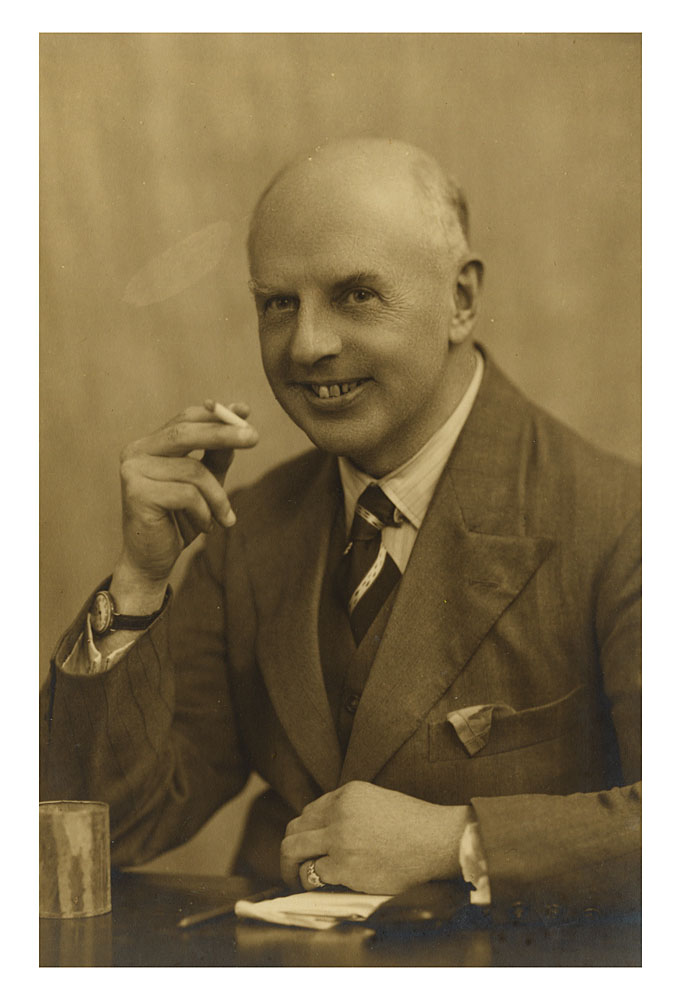
Fig. 1: John Bancrot Willans (https://www.peoplescollection.wales/items/32251)


Among the objects from material sent to Willans in 1903, said to be from Abydos, is a limestone fragment of an ꜣḫ i͗ḳr n Rꜥ stela (AB129). On the left, the dedicatee is seated on a high-backed chair wearing a wig with fillet and a wesekh-collar (fig. 2). He has a short beard and wears a short wig with a fillet band tied around it. The curved end of the top of the chair can be seen just above the collar. In his left hand he holds a lotus-flower, which sinuously curls away from his body with its blossom looping back towards his face, giving the impression that he is sniffing its pleasing fragrance. In his right hand the dedicatee appears to be holding a bouquet of flowers, the remains of which can be seen just in front of him. Traces of brown and white paint on the surface. In the lunette above the scene is a text, written in a number of vertical lines. The text, which is incomplete, can be tentatively reconstructed based on other examples of this type. Ancestor stelae were common during the Ramesside Period. This stela was published as part of the Festschrift presented to Prof. Alan Lloyd in 2007 (Griffin 2007). Thanks to the help of Lee Robert McStein, of Monument Men, a 3D model of the stela was created this week and is now available on the museum’s Sketchfab page.

Fig: Ancestor stela


Among the objects are numerous amulets, including wadjet eyes, scarabs, djed-pillars, and deities. Most of these are on display in our amulet case and are regularly used in our mummification activity with school parties. AB5 is a small inscribed faience scarab, the underside of which features a winged serpent to the left of the cartouche of Thutmose III (Mn-ḫpr-Rꜥ). AB6 is a faience uraeus serpent, which rests is upon a rectangular base, with a loop on the back for suspension. The uraeus was the emblem of royalty. AB7 is a red jasper heart amulet, which appears to be a cornice heart amulet (Sousa 2011, 17–20). This type dates to the Twenty-first Dynasty, at the earliest, though most are Late Period (fig. 3).

Fig. 3: Heart amulet


AB106 is copper alloy votive statue of Amun with a plaited beard. The figure is much corroded with one leg missing above the knee (fig. 4). The double-plumed headdress is also missing. Votive statues of Amun (or Amun-Re) were common from the Third Intermediate Period through the Ptolemaic Period. There are also four copper alloy Osiris figures, including one with a suspension loop on the back.

Fig. 4: Copper alloy statue of Amun


Several of the objects date to the Coptic era, including a metal earring with a mother of pearl Coptic cross (AB31). The early cross was similar in shape to the Egyptian ankh. Additionally, the radial lines at the base suggest the hieroglyph for a woman giving birth. This is very similar to two earrings featured in Petrie (1927, pl. 10). Woolley (1907) saw some similarities between Coptic crosses and Coptic fertility figurines. AB71 is a copper alloy square pendant with blue enamel depicting three unlabelled figures. Iconographically, they likely represent one of the saints flanked by Jesus (left) and Mary (right). The saint is shown holding a copy of the Bible, which suggests he represents one of the Four Evangelists (Matthew, Mark, Luke, or John). Since he is also shown quite bald, this can perhaps be narrowed down to John, the most common of the four to be depicted in this way (fig. 5).

Fig. 5: Coptic pendant


As noted previously, Willans received material from Petrie’s excavations at Tarkhan in 1912–1913. These are always interesting since they commonly have grave numbers written on them. So far, we have been able to identify objects from graves 7, 9, 27, 217, 261, 993, 1348, 1621, and 1622. This consists mainly of pottery, stone vessels, and palettes. AB22 is a turtle-shaped stone palette, manufactured from fine-grained greywacke sandstone found in the Wadi Hammamat in Egypt’s Eastern Desert (fig. 6). The animal-shaped (zoomorphic) palettes are from the Naqada II Period, with turtles being one of the rarer shapes and much less common than fish-shaped or bird-shaped palettes. Whilst not unprecedented in its lack of detail, this example is more stylised than other turtles and doesn’t feature eyes, limbs, or a suspension hole.

Fig. 6: Turtle-shaped palette


Most of the pottery from Tarkhan in the Egypt Centre has been studied by Swansea University students as part of our weekly pottery project taking place this semester. Most are cylindrical jars, with a full sequence of these wavy handled vessels seemingly being sent to Willans in 1913. Particularly noteworthy is AB90, which still contains the original contents, which has resulted in the vessel splitting (fig. 7). It is hoped that the contents of this vessel will be analysed at some point, as is currently being undertaken on another vessel from Tarkhan (AB98) by Alice Law at Cardiff University Conservation Department. Previous analysis on AB98 indicated that it was potentially pig fat (Hardy & Finch (2017).

Fig. 7: Cylindrical vessel with contents


We are immensely grateful to Aberystwyth University and the School of Art for gifting these objects to the Egypt Centre. They represent a major component of the collection, which has been used to educate school children, students, and researchers over the past 25 years!

All the objects from the Aberystwyth collection can be viewed on our online catalogue via the following link. Additionally, throughout the day, I’ll be posting highlights of the collection on Twitter!

Bibliography:

Griffin, K. 2007. An ꜣḫ i͗ḳr n Rꜥ stela from the collection of the Egypt Centre, Swansea. In Schneider, Thomas and Kasia Szpakowska (eds), Egyptian stories: a British Egyptological tribute to Alan B. Lloyd on the occasion of his retirement, 137–147. Münster: Ugarit-Verlag.

Hardy, Andrew & Paul Finch 2017. A chemical study of the contents of an Early Dynastic Egyptian storage jar. Pharmaceutical Historian 47 (1), 2–7.

Petrie, W. M. Flinders, G. A. Wainwright, and A. H. Gardiner 1913. Tarkhan I and Memphis V. British School of Archaeology in Egypt and Egyptian Research Account [23] (19th year). London, Aylesbury: Hazell, Watson and Viney, Ld. [pl. XLIX]

Petrie, W. M. Flinders 1927. Objects of daily use: with over 1800 figures from University College, London. British School of Archaeology in Egypt and Egyptian Research Account [42]. London: British School of Archaeology in Egypt; Bernard Quaritch.

Sousa, Rogério 2011. The heart of wisdom: studies on the heart amulet in ancient Egypt. BAR International Series 2211. Oxford: Archaeopress.

Woolley, C. Leonard 1907. Coptic bone figures. Proceedings of the Society of Biblical Archaeology Proceedings 29, 218–220.

Monday, 14 March 2022

A Wellcome Reunion?

The blog post for this week has been written by Egypt Centre volunteer and University of Birmingham PhD student, Sam Powell, who is a regular contributor to this blog.

As regular attendees to Ken’s courses will know, I am currently visiting various institutions across the UK to gather data on the wooden funerary figures from tomb models as part of my PhD research. My aim is to build a stylistic typology of these figures as a means of establishing a likely provenance for unprovenanced examples. As this research builds upon my MA dissertation focusing on the figures held in the Egypt Centre, this week’s topic of “Funerary Figures” seemed a great time to provide an update on some of my findings relating to a group of these figures held in the Egypt Centre.

For those taking Ken’s course, you may remember one of the figures included in week two (W445), a lovely squatting figure from a kitchen scene roasting a goose over a fire. This figure was assembled by the amazing team at Cardiff University’s conservation department in 2020 thanks to a grant from the AIM Pilgrim Trust. This figure is one of five similar figures held by the Egypt Centre, coming from the dispersal of the collection of Sir Henry Wellcome (fig. 1).

Fig. 1: The five squatting figures of the Egypt Centre

As many of you know, the Egypt Centre was not the only institution to receive Wellcome material, and as I have found travelling to the World Museum in Liverpool, the material was not dispersed in the most logical groupings! My research visit to the stores at the World Museum took place over several days, and Ashley Cooke, Curator of Ancient Egypt, very generously gave me a tour of some of the amazing objects they have. In amongst the seventy-plus figures I examined, two in particular looked very familiar to me; 1973.1.571 and 1973.1.572 (fig. 2).

Fig. 2: Figures 1973.1.571 and 1973.1.572, World Museum, Liverpool


The type of wood struck me immediately as being similar to the squatting kitchen crew residing in the Egypt Centre. Stylistically, they were certainly comparable, but in different positions; 1973.1.571 is shown with slightly bent knees, whilst 1973.1.572 is kneeling rather than squatting. Both of these figures also come from the Wellcome collection, but unfortunately no further provenance is known.

Ashley was also kind enough to let me look at the loose arms and additional “bits” of wood that seem to inhabit every museum store to see if anything looked a potential match for the figures I was researching. I managed to reunite around a dozen arms to their rightful figures (one of my favourite parts of this research). Two of these reunited arms were matches for the Wellcome figures, most crucially for 1973.1.572, the hand of the reunited arm is holding a ball of dough, allowing an identification of this figure as a baker (fig. 3). This was particularly exciting as I had assumed that all the figures in the Egypt Centre were roasting fowl in the same manner as W445, but it now seems more likely that they are part of a larger collection depicting various scenes of food production. Several other arms that match this group of figures are held in the stores in both Liverpool and Swansea, but it is difficult to match them without physically reuniting the material.


Fig. 3: Figures 1973.1.571 and 1973.1.572, World Museum, Liverpool with their reunited arms

Whilst looking for another figure, I also spotted another piece of wood that instantly caught my eye… (fig. 4).

Fig. 4: The fragment of wood, 1973.2.9, World Museum, Liverpool


After working with the Egypt Centre figures for so long, this unassuming piece of wood was clearly (well clearly for someone obsessed with these figures!) the knees of squatting figure W453 in the Egypt Centre. I brought up the figure in my database to check sizes, and sure enough, these knees seem to be a match (fig. 5)!

Fig. 5: Figure W453, The Egypt Centre, virtually reunited with its knees, 1973.2.9, World Museum, Liverpool

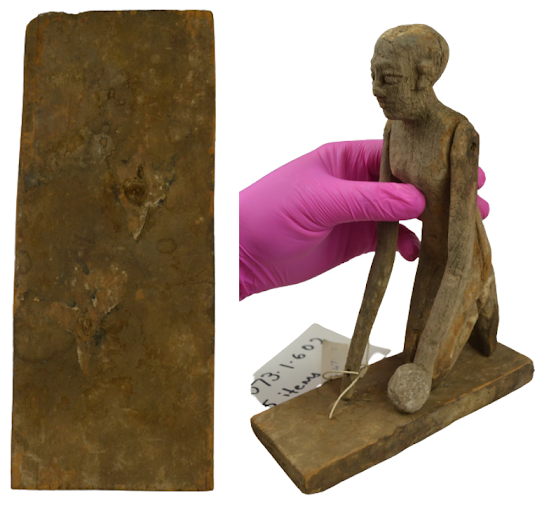
The final elements for these figures were some planks of wood, which appear to be the bases for tomb models, also coming from the Wellcome dispersal. Sure enough, the sizes match these figures and the wear patterns seem consistent, although again, without physically reuniting these objects it is difficult to establish which base would belong with each figure (figs. 6 & 7).

Fig. 6: Figure 1973.1.572, and base 1973.1.602, World Museum, Liverpool


The figures were purchased by Wellcome as part of the Sotheby & Co auction of the collection of Frankland Hood on 12–13 November 1928, lot 218, which describes “ten well-modelled Figures of artisans including two soldiers, 12th Dynasty, in good condition”. The five Egypt Centre figures, plus the two ‘soldiers’ (actually offering bearers W447 and W448) bring the total to seven. The two additional figures of the World Museum bring the total to nine leaving one unaccounted for figure. They are noted as coming from the MacGregor sale in 1922, but it is unclear as to the number of figures at that time, or whether they all came from the same provenance. As my research visits continue around the country, with many more recipients of Wellcome material to visit, my hope is that the final figure and further elements of these models may emerge and shed further light on this fascinating assemblage of funerary figures.

Fig. 7: Likely bases for the Egypt Centre squatting figures, 1973.1.574, and 1973.1.575, World Museum, Liverpool


It would be fantastic to be able to physically reunite these figures, but even to virtually bring these objects back together is very satisfying. Perhaps with the advances in 3D printing, it may be possible to replicate the individual components to create the complete scene.

I would like to finish this post by expressing my thanks to Ken Griffin at the Egypt Centre, Ashley Cooke at the World Museum, and all the other institutions that have been kind enough to facilitate my research visits; here’s hoping for plenty more discoveries!

Tuesday, 8 March 2022

A Visit to the Cardiff Conservation Department

On Monday 06 March, I led a group of Swansea University students to Cardiff University to visit the work performed by the Conservation Department. The Egypt Centre currently has over fifty objects in Cardiff, ranging from a complete wooden coffin, pottery, stelae, painted plaster from Amarna, and coffin clamps. Archives show that objects in the Egypt Centre collection have been sent to Cardiff for conservation treatment since at least 1978. Over the past forty years, some 200+ objects have been treated, many of which are now on display in the Egypt Centre. This blog post will briefly review the trip to Cardiff, highlighting a few of the Egypt Centre objects the students had the opportunity to see.

The tour of the Conservation Department was led by Phil Parkes (Reader in Conservation), who I’ve been working with closely since being appointed Collections Access Manager at the Egypt Centre. Phil (fig. 1) started off by informing the group that the conservation work is undertaken for free by carefully supervised students as part of their degree scheme. Students enrolled in the BSc in the Conservation of Objects in Museums and Archaeology, or an MSc in Conservation Practice carry out hands-on conservation work of genuine museum objects taught by accredited conservators. This agreement benefits both parties since the Egypt Centre is able to support students with object information, context, and feedback to shape their conservation decisions. In return, Cardiff students deliver a constant supply of conserved objects ready for display in the museum.

Fig. 1: Phil giving his talk about the department


One of the highlights of the visit was AB118, a wooden coffin gifted to the Egypt Centre in 1997 by Aberystwyth University. At the time, the coffin was in a terrible state, with the dowels of the wood broken in several places, which resulted in the object splitting apart. Additionally, the wood was covered in a layer of gesso-painted linen, which has become detached from the coffin over the years. The coffin arrived in Cardiff over twenty years ago and has been worked on by numerous students over the years. The coffin lid (fig. 2) is now largely finished, so work has now moved to the trough. This is currently being held together by plastic bands until it can be properly stabilised and repaired (fig. 3).

Fig. 2: Coffin lid following conservation (Ⓒ Cardiff Conservation Department)


The coffin is particularly interesting since it is an excellent example of reuse. On the interior of the coffin, and at least twice on the exterior, the deceased is listed as Ankhpakhered. While he doesn’t possess titles, both his parents are both listed. The decorative scheme indicates that the coffin was manufactured during the Twenty-fifth–Twenty-sixth Dynasty. However, on the exterior of the lid, the owner is listed as Djedhor, who was a Stolist at Akhmim. The areas where Djedhor’s name and titles appear are obvious since they have a clear white background, which is offset from the rest of the coffin. It is unclear when the coffin was usurped by Djedhor. However, when the coffin arrived in Swansea, there were three pieces of cartonnage contained within (AB124, AB125, AB126), which date to the Ptolemaic Period. Where these part of the burial of Djedhor? Perhaps not. Records indicate that the body of a deceased individual was housed within the coffin until the 1950s, but when it was examined it turned out to be that of a woman!

Fig. 3: Coffin though awaiting conservation


During the tour, students were able to see the plaster cast of the statue base of Djedhor the Saviour (W302), which was sent to Cardiff just a few months ago (fig. 4). Avid readers of this blog will know that the statue accompanying this base is currently housed in the Petrie Museum. However, in August 2021, the UCL Culture Heritage and Museums committee agreed to transfer the plaster cast of the statue of Djedhor the Saviour to Swansea to be reunited with the base. The transfer of the statue is expected to take place in the summer of 2022. While the structure of the base is excellent, there are numerous chips to the surface, which will require treatment before both the statue and the base can be displayed in the museum.

Fig. 4: Statue base of Djedhor the Saviour


We are immensely grateful to Phil, Ashley Lingle, and the rest of the conservation team for all their cooperation in working on the Egypt Centre collection. We are proud to have contributed to the development of numerous conservation students over the years, helping to offer hands-on experience with our collection. Thank you! 

Monday, 28 February 2022

A Return to Object-Based Learning at the Egypt Centre

Many readers of this blog will know that the Egypt Centre is a strong advocate of object-based learning (OBL). Several blog posts have previously highlighted handling sessions delivered to Swansea University students and other audiences. While the COVID-19 Pandemic meant that in-person handing sessions couldn’t take place, since October 2021 these have been able to resume again. This semester is particularly busy as the Egypt Centre works with colleagues in the Faculty of Humanities and Social Sciences at Swansea University. This short blog post will briefly highlight some of the exciting opportunities provided to Swansea University students this semester.

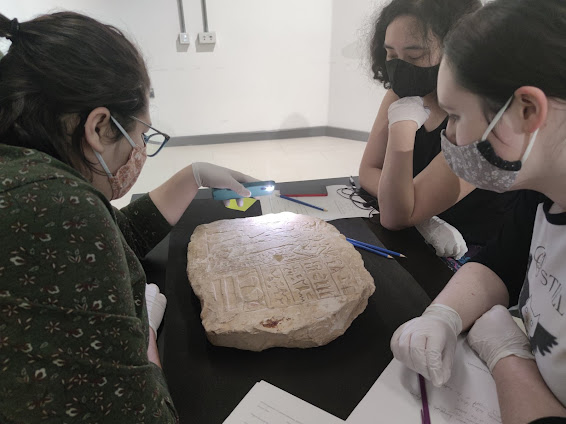
Fig. 1: Students examining a First Intermediate Period stela (EC148)


Second-year Egyptology students have had weekly handling sessions as part of a module led by Dr Christian Knoblauch on Egyptian Art and Architecture (CLE220). So far, they have had weeks on sculpture and relief, while the most recent session looked at the art of the Old Kingdom. These handling sessions are directly related to assessment, so the students are always very attentive. Students spend approximately fifteen minutes examining an object before switching to another one (fig. 1). In total, they have the opportunity to examine five to six objects per session. At the end, students are asked to stand next to the object they liked the most, which is always a fun experiment!


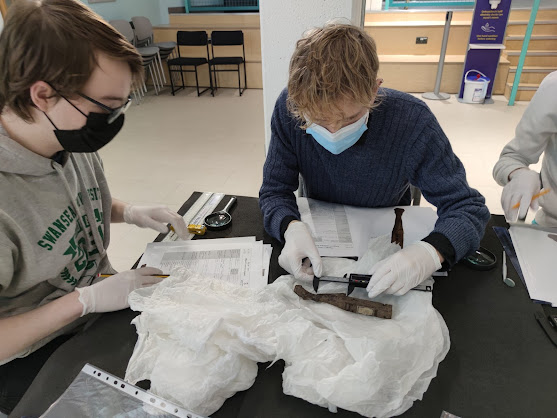
Fig. 2: Students practising conditions reports


For many years now, Egypt Centre staff have been directly involved in teaching an MA module (CL-M77) called Reaching the Public: Museums and Object Handling. During this module, students explore topics such as museum ethics, education in museums, preventive conservation, and object-based learning. As part of their assessment, students have to undertake a condition report on an unseen object from the collection. Additionally, they are required to select four objects from the collection, based around a common theme of their choice, before delivering a thirty-minute handling session to an audience. In order to prepare the students for these assessments, they have been able to handle objects over the past few weeks (fig. 2). For example, last Monday students were provided with five objects and were asked to utilise all their senses when examining them (fig. 3). They were also introduced to the Visible Thinking Strategy (VTS), which further encourages students to think critically about museum objects.


Fig. 3: ‘Objects in teaching and learning’ (Flinders University Museum of Art)


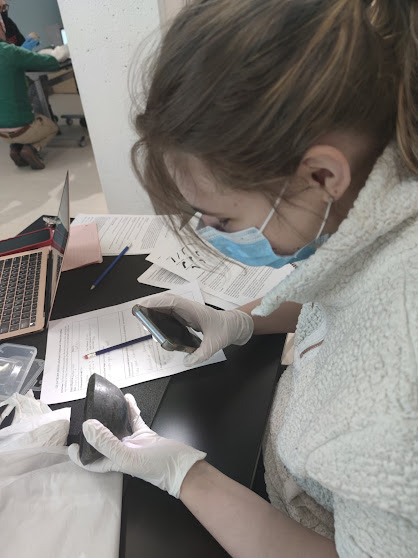
A special project started this year is the Swansea University Pottery Project (SUPP), a collaboration between Dr Christian Knoblauch and I. The aim of this project is to fully document all the pottery in the Egypt Centre collection, including providing detailed descriptions, measurements, classifications, new photography, and eventually drawings. Eleven students, ranging from first-year students right through to PhD level, have been selected to undertake these tasks. The project itself is expected to last for two years, if not more, so while some students will be able to continue with the project in the next academic year, new students will also have the opportunity to join us. This is an extramural project that doesn’t carry any credits or have any assessments, but it is clearly one that the students enjoy immensely since some of them regularly turn up ahead of the time slot so that they can start working on the objects (fig. 4). The project has already been successful so far in identifying some new provenances for some of the vessels, including one from Naqada and another from Meroe. More details about this project will follow in a separate blog post!


Fig. 4: Bethany closely examining a vessel from Meroe (W742)


Feedback from students indicates how much they enjoy these sessions and appreciate the opportunity to work directly with the Egypt Centre collection. It’s certainly wonderful to be back offering these sessions in person rather than virtually, as was the case in the last academic year!

Monday, 21 February 2022

In the Service of the Gods: The Role of Priestesses

The blog post for this week is written by Linda Kimmel, from Ann Arbor, Michigan, in the United States. When she retired from full-time work as a data research manager in late 2020, she began studying about the ancient world, and serving as a docent at the University of Michigan’s Kelsey Museum of Archaeology. Linda had never heard of the Egypt Centre before the pandemic but has taken every course offered since she first noticed a tweet about the museum in the fall of 2020 and hopes to visit Swansea in late 2022 or 2023.

The last five weeks flew by as I spent my Sunday afternoons (U.S. time) enjoying the latest Egypt Centre course, In the Service of the Gods: Priests and Priestesses in Ancient Egypt, taught by Ken Griffin. While I was sad that the course was ending, I had looked forward to the final class, the role of priestesses, the entire course. Despite the claim by Herodotus that “no woman holds priestly office, either in the service of goddess or god; only men and priests in both cases” (Herodotus II, 35), we saw in both this class and the one the week before, that women filled many roles “in the service of goddess or god”. Additionally, these roles often changed over time. Women held a wide variety of titles connected to temples, although it is unclear how many were functional rather than honorific.

The titles women held varied with some being regional, and others connected to specific gods and goddesses. In our final class, Ken introduced us to many different titles held by women, including the Priestess of Hathor, the Priestess of Mut, and the Priestess of Min. We learned that female priestly roles were downgraded during the New Kingdom. At the same time, the roles of female musicians became more prominent. I was particularly intrigued by the title of Chantress and the associated Kheneret. I wanted to know more about female musicians in ancient Egypt!

Fig. 1: Female musicians with instruments (MMA 30.4.9)


Music is an important element in many religions, both ancient and modern, and the religion of ancient Egypt was no exception. For the ancient Egyptians, music served to appease the gods. While there are examples of male musicians, musicians were primarily female. It was believed that the gods were fond of music and could be “pacified” by a woman’s voice (Onstine 2005). Musicians are easy to identify in tomb reliefs by the instruments they carry, such as in this relief from Theban Tomb 38 (fig. 1).

The title of Chantress is one of the most common found for women in ancient Egypt. While priestesses reached a peak during the Old Kingdom, the title of Chantress was originally attested in the Old Kingdom but became more common in the New Kingdom. Initially, most of the women who held the title of Chantress seem to have been from elite, and even royal, families. However, as time went on, Chantresses were drawn from less elite families. In fact, the title of Chantress eventually became so common that some Egyptologists estimate that most households probably had one. Some women held multiple titles, and their titles could be associated with specific gods, such as the Chantress of Amun and the Singer of Khonsu.

Fig. 2: Image of the sistrum at the Egypt Centre (W553


But what did a Chantress do? They seem to have been responsible for singing and playing musical instruments in temple activities and festivals, and in funeral processions. They are commonly depicted carrying sistra and other musical instruments. Sistra are often associated with the goddess Hathor and were shaken to produce a noise. Graves-Brown (2010, 96) suggests that the “sistrum was shaken to drive away hostile forces and revive the gods”. The Egypt Centre has an intriguing bronze sistrum (fig. 2) dated from the Late Period to the Graeco-Roman Period that includes images of both Hathor and Bes. Chantresses can also be depicted clapping in a rhythmic manner and holding a menat, a form of jewelry also associated with the goddess Hathor (figs. 3–4). Like a sistrum, the menat necklace could be shaken to produce a swishing sound from the beads (Emerit 2013).

Fig. 3: Hathor presenting Menat necklace to Seti I (Louvre B 7)
 

The Chantress was originally associated with the Kheneret, but rather than being a single individual, the Kheneret was a group. The exact meaning of the group has been disputed. Early Egyptologists translated the word as meaning a “harem,” with a host of disparaging connotations. More recently, the term has been translated as a “musical troupe,” or a group of musicians who had an important role in Egyptian religion. The Kheneret are most frequently attested during the Old and Middle Kingdoms, but rarely during the New Kingdom. As with the title of Chantress, the Kheneret could be attached to specific deities, with the most common association to Hathor. The Kheneret were often associated with the palace, with the King’s daughters shown as participants. We learned about an interesting association between the Kheneret and an artifact found in many museums, such as one in the Egypt Centre (fig. 5): the paddle doll. These paddle dolls have been identified in a variety of ways by Egyptologists from actual dolls to signs of sexuality, to associations with the goddess Hathor. Ken introduced us to an article by Ellen Morris (2011) who believes the dolls represent members of the Kheneret.

Fig. 4: Menat necklace from Malqata (MMA 11.215.450)


Many details are still unclear about the titles of Chantress and Kheneret. For example, how much access did the musicians have to the temples? Did they have access to the inner sanctums of the temples or were they limited to the courtyards? Similarly, where did they live? We know male priests lived within the temple complex. However, so far, there is no evidence as to whether these female musicians lived within the temples or had their own homes.

Fig. 5: Paddle Doll in the Egypt Centre (W769)


What do we know about the women who held these positions, and how do we know it? These questions led to an exploration of a major source of information: burial equipment. From artefacts such as mummy bandages, coffins, and shabtis, we often know the names of the women, their family members, and the titles held by their family members. From such sources we know that many of the women were married to priests, although they might not have served the same gods. Some of these women are also identified by the burial equipment of their family members. For example, a mummy bandage in the Egypt Centre reveals that the deceased’s mother was the Sistrum Player of Amun-Re (fig. 6).

Fig. 6: Mummy bandage mentioning a Sistrum Player of Amun-Re (W901)


The class ended with an in-depth look at some of the funerary equipment, including an inner coffin of the Chantress of Amun, Iwesenhesetmut (fig. 7). She held this title during the Twenty-first Dynasty. Her exact tomb location is unknown but is believed to be in Western Thebes. There is a fascinating post from late last year about this equipment at the Egypt Centre blog, which can be read here.  

Fig. 7: Inner coffin of Iwesenhesetmut (W1982)


I remain sad this course is over; I could easily do another five weeks or more on the topic. But in the meantime, I will be catching up with some of the wonderful articles Ken has sent us each week, while waiting for the next course, The Funerary Artefacts of the Ancient Egyptians, to start on February 27, 2022.

Bibliography:

Emerit, Sibylle 2013. Music and musicians. Edited by Willeke Wendrich. UCLA Encyclopedia of Egyptology 2013 (July).

Graves-Brown, Carolyn 2010. Dancing for Hathor: women in ancient Egypt. London: Continuum.

Morris, Ellen F. 2011. Paddle dolls and performance. Journal of the American Research Center in Egypt 47, 71–103.

Onstine, Suzanne Lynn 2005. The role of the chantress (šmꜥyt) in ancient Egypt. BAR International Series 1401. Oxford: Archaeopress.

Monday, 14 February 2022

The God's Wives of Amun

 This blog is written by Pam Llewellin and covers the fourth in the series of lectures on The Service of the Gods; Priests and Priestesses in Ancient Egypt. Pam is retired and now has the time to develop her special interest in ancient religions, particularly the gods and goddesses of ancient Egypt. She co-administers two ancient Egyptian history websites with 13,000 members in the US and around the world, and is a regular visitor to Egypt with a particular interest/obsession with Karnak Temple.

In his fourth lecture of the course In the Service of the Gods: Priests and Priestesses in Ancient Egypt, Dr Griffin discussed the God’s Wives of Amun; the office closely associated with the service of the god at the great temple of Amun at Karnak. Dr Griffin mostly covered the periods of the Twenty-fifth and Twenty-sixth Dynasties (fig. 1). The Egyptian name for this title was ḥmt ntr n I͗mn and Dr Griffin tells us that the role was active from the Middle Kingdom onwards but came to economic and political prominence during the Eighteenth Dynasty. Most of those holding the title of the God’s Wife of Amun, prior to the Third Intermediate Period, were married to and appointed by the ruler of the time at the period when the creator god Amun became the main god worshipped at Karnak, and which also saw the role of High Priest of Amun increase in importance within the temple hierarchy. The role would later be inherited by the daughter of the king through being “adopted” by her predecessor.

Fig. 1: The God's Wife Amenirdis I

To the ancient Egyptians, the concept of a mortal woman in union with the supreme god Amun as his wife and consort, was completely acceptable, particularly when it came to temple rituals and religious festivals where she could be seen portraying this role alongside Amun’s divine wives, Mut and Amunet (fig. 2). There has been some conjecture as to the role of the God’s Hand title within the office which implies that one of the God’s Wife’s duties was to “stimulate” the god sexually, believed to be achieved perhaps, by shaking her sistrum. Miriam Ayad queries this theory and points out the instances of many pharaohs and priests holding/shaking sistra, with no sexual connotation. As with so many other rituals and practices, we don’t have the evidence to substantiate this claim in one way or the other.


Fig. 2: An unnamed God's Wife performing the Ritual Buring of Fans

Her other duties, as well as the ceremonies and rituals associated with the office are somewhat shrouded in mystery. The little information we do have comes from texts, and iconography on the temples, papyri and from their chapel walls. We know she performed a priestly role and would sometimes partake in the rituals usually associated with the pharaohs, such as the “burning of the fans” or the “stretching the cord” at the early construction of a temple (fig. 3). Her iconography includes the vulture headdress, the double plumes of Amun, the modius, the sistrum, the fly whisk, baton, and a circlet.


Fig. 3: Shepenwepet II stretching the cord

One appointment of significance is that of King Ahmose II (c.1552–1527 BC) who purchased the office of priesthood for his Great Royal Wife and half-sister. In so doing, Ahmose resurrected an obscure Middle Kingdom title and gave it national importance by linking it to the cult of Amun, helping to cement his own status in the newly united Egypt. This new title would be displayed on the Donation Stela in which the new God’s Wife of Amun, Ahmose-Nefertari, is depicted (fig. 4). The stela establishing the perpetual right of the heirs of the God’s Wife to the title, office, and the economic benefits from the temple estates and to keep the successors’ independence from future generations of rulership.

Fig. 4: The Donation Stela of Ahmose II

Ramesses VI conveyed the title of God’s Wife to his daughter Isis, in an effort to bolster his power at Thebes (fig. 5). She held the office for twenty-five years and survived into the reign of Ramesses X. She is probably the first God’s Wife to live in celibacy with no evidence that she was married. While other women had held the title of Gods Wife, God’s Hand, and Divine Adoratrice, only three held all three titles: Henuttawy of the Twenty-first Dynasty; Karomama Meritmut of the Twenty-second Dynasty, and Maatkare I Mutemhat, daughter of King Psusennes I of the Twenty-sixth dynasty. Karomama Meritmut is possibly the daughter of Osorkon II of the Twenty-second Dynasty and was adopted by Henuttawy as heir and successor to the office. The overseer of her treasury Ahentefnakht presented her with the now famous bronze statue of Karomama Meritmut, the Divine Adoratrice of Amun, now on display in the Louvre Museum in Paris. When Maatkare’s mummy was discovered in the Deir el-Bahari cache, it was initially thought that she was buried with the mummy of a child alongside her, thus debunking the idea of religious celibacy. Later technology would reveal that it was the mummified body of a baboon thereby protecting her reputation as celibate.


Fig. 5: The God's Wife Isis before Osiris

Prior to the invasion of Egypt by the Nubians, the God’s Wife of Amun was already a prominent individual in Thebes and was quickly recognised by the Nubians as having great political potential. Shepenwepet I was the daughter of Osorkon III (777–749 BC) and was a single woman with no record of a husband or of her having had children (fig. 6). She was the only God’s Wife to bear the royal titles Lord of the Two Lands and Lord of Appearances. Shepenwepet was compelled to adopt Amenirdis I, the Nubian daughter of Kashta, the monarch of the Twenty-fifth Dynasty, and name her as her successor and chosen heir. Shepenwepet I and Amenirdis I are depicted together in a rock drawing in Wadi Gasus. It is thought she is buried in a chapel at Medinet Habu.

Fig. 1: Shepenwepet being suckled by Hathor

Amenirdis I would be in office from 714–700 BC, and would adopt Piye’s daughter Shepenwepet II as her successor and heir. She was buried in a tomb in the grounds of Medinet Habu. Shepenwepet II was appointed as the God’s Wife during the reign of Shebitqo. During her term of office, she completed the funerary chapel of Amenirdis I and had her own funerary chapel constructed alongside the woman who had “adopted” her (fig. 7).


Fig. 7: Shepenwepet II before Harakhty, Isis, and Amenirdis I


The political climate changes during the Saite Period when Psamtek of the Twenty-sixth Dynasty becomes pharaoh and appoints his daughter Nitokris I to be God’s Wife and moves her from the Delta to Thebes. As Nitokris I was only a child when her father appointed her to be God’s Wife, she was able to keep the office for seventy years, from 655–585 BC (fig. 8). Before the previous holders of the office both died, the title of God’s Wife appears to have become less important and the main title would become that of Divine Adoratrice. It is at this time that the office of High Priest of Amun also appears to have disappeared. This could possibly be linked to the association between Amun and the unpopular Kushites and, as the god Amun was not the main god of Lower Egypt, his worship and influence would be overtaken by the cult of Osiris and Isis which inevitably weakened the political power and influence of the Priesthood of Amun at Karnak. The next God’s Wife was Ankhnesneferibre the daughter of Psamtek II who was made successor to the office by Nitokris I in the middle of the Twenty-sixth Dynasty. As far as we know, she is the last God’s Wife of Amun as it is questionable whether her “adopted” successor. Nitokris II. ever took up the office and the role was completely abolished when the Persians invaded Egypt and took control of the country.


Fig. 8: Nitokris I and her High Steward Pabasa


To conclude the session, Dr Griffin concentrated his talk on Princess Neferure, the daughter of Tuthmose II and the successor of her mother, Hatshepsut, who had been the God’s Wife of Amun prior her becoming the ruler of Egypt. Dr Griffin showed us W1376 from the Egypt Centre, a relief of a female figure and how, through a process of research and observation, he was able to determine that this was someone of royalty (fig. 9). He was able to determine that the figure was a female by the hieroglyph by the presence of the female pronoun in the inscription. The key to conclusively identifying the image was the hardly noticeable modius above the head on the relief, as it had been erased, but when he compared it with other images was able to confirm that the relief was Neferure. Neferure was quite young when she took up the office of God’s Wife. There are images of Neferure in several temples, including the Netjery-menu at Karnak and the Funerary Temple of Hatshepsut. Her tomb is at Wadi Gabbanat el-Qurud on the West Bank of Luxor.


Fig. 9: Relief of Neferure (W1376)


Mariam Ayad said in a recent television programme on Sacred Sites that the role of God’s Wife was akin to “that of a Medieval Pope”, and we have been shown how the role of God’s Wife could have been used as a vehicle for retaining or transmitting royal political power. How this power was used by the holder of the office is something we might never get to know but it does seem quite telling that the stewards who served the God’s Wife built some of the largest tombs ever found, whilst the God’s Wife’s tombs are more modest in comparison. However, they would leave us the legacy of their contribution to ancient Egyptian architecture by building beautiful temples and funerary chapels and their history would influence the Ptolemaic queens of Egypt who would borrow their titularies possibly in an attempt to legitimise their rule by linking with these prominent female figures from the Egyptian past. These would forever be the lasting legacies of the God’s Wife of Amun.

Bibliography:

Ayad, Mariam F. 2009. God’s Wife, God’s Servant: the God’s Wife of Amun (ca.740–525 BC). London; New York: Routledge.