Monday, 7 February 2022

The Priesthood of Amun, or Keep It in the Family!

The blog post for this week is written by Jeanne Whitehurst, who has completed her Certificate of Egyptology from the University of Manchester. She moved to Egypt over ten years ago, just before the revolution. Initially, she lived in Luxor, overlooking Karnak Temple, but now she lives in Aswan overlooking the First Cataract. She was extremely fortunate to have worked with Ted Brock on the sarcophagus of Merenptah (KV 8) as a volunteer.

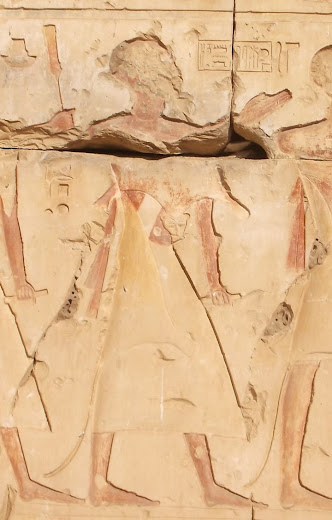
The magnificent Karnak Temple in modern-day Luxor named ipet-sut (“The Most Select of Places”) was the cult temple of the main god Amun, who was worshipped there along with his wife Mut and their son Khonsu. Together, they formed the Theban Triad. Karnak has many temples inside its mudbrick walls besides those dedicated to the Theban Triad. It is said to be one of the largest religious sites in the world.

Throughout Egypt’s history, the priesthood would serve a vital role in maintaining religious beliefs and traditions with male priests known as hem-netjer (Servants of the God). There was a hierarchy in the priesthood from the High Priest (hem-netjer-tepy, “First God’s Servant”) at the top and the wab-priests lower down. The wab-priests carried out the essential but mundane tasks of taking care of the temple complex and performing whatever function they were called upon, such as helping to prepare for festivals. There was a First God’s Servant (High Priest), a Second, Third and Fourth God’s Servant. However, it doesn’t necessarily follow this order of importance, as can be seen with the Fourth God’s Servant, Montuemhat, leading a procession while the First God’s Servant is behind him (fig. 1). They were then divided into four phyles, a sub-division of twenty priests. There are many interesting titles, including “chief of the manufacturer of wigs of Amun in Karnak”. Nefermenu held this title and several other titles including “scribe of the treasury of Amun”, “master of the divine seal”, “keeper of the balance of Amun” and “opener of the doors of the sky”. The latter was specific to Karnak and there has been much speculation as to its meaning, including that it might relate to the responsibility to the opening of the shrine.


Fig. 1: The Saite Oracle Papyrus (Brooklyn Museum 47.218.3a-j https://www.brooklynmuseum.org/opencollection/objects/60645)


At Karnak, the male priests lived inside the temple, at least during the First Millennium BC. Not all priests of Amun (fig. 2) worked in Karnak though as there is evidence of High Priests of Amun at Tanis during the Twenty-first Dynasty (1069–945 BC). During the reign of Rameses III, the labour force consisted of more than 81,000 people while the temple comprised of 3 orchards, 421,000 heads of livestock, 65 villages, 83 ships, and 46 workshops with hundreds of acres of farmland (according to the Great Harris Papyrus). One of the reasons they accumulated this wealth was by being exempt from paying taxes from the end of the Old Kingdom, which allowed the priests of Amun to become very powerful with vast estates and wealth. It is thought that one of the main reasons why Akhenaten moved his capital to Amarna was because the priests had become too powerful and were challenging his reign. Other pharaohs such as Thutmose III tried to stem this power by removing the hereditary rights of the priests.


Fig. 2: Shabti of the Prophet of Amun, Ankhwennefer (W660)


Evidence, perhaps slightly one-sided, is found through their burial goods, tombs, statues, stelae, temple reliefs, letters, annals, decrees, and graffiti, showing these high priests wielded great power and could affect the course of history and even rival the pharaoh himself. One example of this, which began in the New Kingdom with the regular Opet Festival, involved the oracle of Amun. The priests had the power to interpret the responses of the god, giving their answers with a yes (forward movement) or no (back movement) answer. Civil and criminal cases, matters of policy, domestic issues, and building policies were all decided at Thebes by these senior priests of Amun. An example of this is when the royal tomb builders at Deir el-Medina went on strike during the reign of Ramesses III by striking. Priestly dynasties were established as a father’s offices were passed down to his sons, and members of distinguished families intermarried to consolidate and improve their social positions. Eventually, at the end of the Twentieth Dynasty a semi-autonomous state emerged in the Theban area, ruled over by these priests. Some even styled themselves local monarchs with their names in cartouches on the walls of Karnak (fig. 3). How widespread their influence was is uncertain, but it does emphasize the power of the High Priests of Amun at this time.


Fig. 3: The High Priest Herihor depicted as a Pharaoh

Below are just a few High Priests of Amun with their very short biographies.

Hapuseneb: Reign of Hatshepsut (1473–1458 BC) from year 2 to 16: Tomb TT 67 (Sheikh Abd El Qurna).

In addition to being High priest and Vizier of the South, he was also responsible for the building of a ship, a gate, a shrine, door wings, and buildings besides the production of temple equipment. He was also the “Overseer of the construction of a royal tomb, although it is not clear whether KV 20 is meant. In the passage of his tomb, Hapuseneb’s parents are mentioned. His father, Hepu, was a Third Lector Priest of Amun.

Nebwenenef: Reign of Ramesses II (1279–1213 BC): Tomb TT 157 (Dra’ Abu el-Naga).

Nebwenenef was appointed at the beginning of the long reign of Ramesses II. In an oracle interpreted by the king when he went to Thebes to celebrate the great annual festival of Amun, the god himself insisted that of all the candidates only Nebwenenef would satisfy him. Nebwenenef was at that time High Priest of the god Anhur at Thinis and High Priest of the goddess Hathor of Dendera. In his tomb, Nebwenenef depicts this story and in a famous relief, shows his audience with the King and Queen Nefertari at the palace for his formal installation. Neb­wenenef died less than seventeen years later (fig. 4). However, Nebwenenef was afforded the rare privilege of having his own mortuary temple, near the temple of Seti I. During the whole of the New Kingdom, only one other commoner, Amenhotep Son of Hapu, is known to have been honoured in this way.


Fig. 4: Shabti of the High Priest of Amun Nebwenenef (WK28)


Bakenkhonsu (I): Reign of Ramesses II: Tomb TT 35 (Sheikh Abd el-Qurna).
Bakenkhonsu was descended from a family of priests. His father was the First and Second Prophet of Amun whilst his mother was a Singer of Amun. He started his career under the pharaoh Seti I and continued under Ramesses II, initially as a wab-priest before progressing to Second, Third, and Four Prophets of Amun. Eventually, he because High Priest. He lived to at least seventy, but experts differ as to exactly how old he was when he died. There is a block statue of him in Munich Museum where he addresses future generations and gives a detailed account of his career.


Fig. 5: Statue of Bakenkhonsu in Munich (https://en.wikipedia.org/wiki/Bakenkhonsu#/media/File:Statue_of_Bakenkhonsu_2017-09-12.jpg)


Ramessesnakht: Ramesses IV–Ramesses IX: Tomb: TT 293.
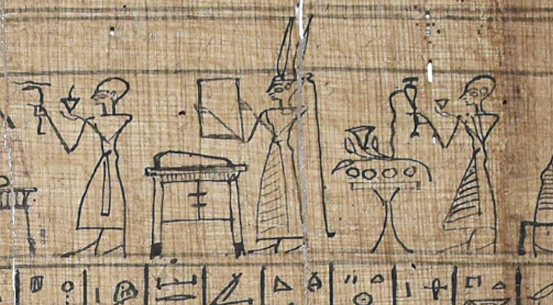
Ramessesnakht (fig. 6) was married to Adjedet-Aat and had at least two sons and a daughter Tamerit. She was married to the Third Prophet of Amun, Amenemope (TT 148). It is known that Ramessesnakht went on a quarrying expedition to the Wadi Hammamat during the reign of Ramesses IV and secured gold and galena (for eye paint). A rock-cut stela in the Wadi Hammamat records his expedition reporting in year 3 of Ramesses IV that the High Priest Ramessesnakht lead an expedition consisting of some 8,368 men, including a fully organised division of the Egyptian army.


Fig. 6: Ramessesnakht offering to the gods


Herihor: Ramesses XI: Tomb not known.

Herihor served as High Priest and was also General. He was married to the lady Nodjmet, who may have been a sister of Ramesses XI. Herihor was the first of the High Priests to assume royal powers. During his reign, some tombs were found to be in need of “renewing the burial”. The tombs of Ramesses I, Seti I, and Rameses II required “renewing” after pillaging.

Pinudjem II990–976 BC. Buried in DB 320 (Deir el-Bahari cache)

His titles included High Priest of Amun-Re, Great Chief of the Army, and Overseer of the Treasury (fig. 7). More importantly, he was the de facto ruler of the south of the country. His tomb was shared with his wife Nesikhonsu, his niece Nesikhonsu (the daughter of the High Priest of Amun), and other family members. Following his death, many of the royal mummies of the New Kingdom and Twenty-first Dynasty were placed in his tomb for safekeeping.


Fig. 7: Pinedjem II before Osiris (British Museum EA 10793)


Priests maintained their position, with greater or lesser degrees of success, through the Ptolemaic Dynasty (332–30 BC) and even into Roman Egypt. However, by the time of the rise of Christianity in the fourth century AD, they had lost most of their power and prestige, leading to the replacement of the old faith with the new one.

This blog has only been able to show a snapshot or a clerestory window of the power, prestige, and importance of the priesthood of Amun on Egyptian history from the New Kingdom onwards.

Monday, 31 January 2022

Servants of the Gods

The blog post for this week has been written by Iris C. Meijer. Iris lives in Luxor, Egypt, and has a deep passion for all things ancient Egyptian. She is currently owned by seventeen rescued cats and dogs and spends her extra time trying to raise awareness for animal welfare.

When we visit Egypt and walk through the vast pylons, columned courtyards and rooms of the temples there, the silent witnesses towering over us conjure up a world of mystic stillness and belief. Empty, they speak of a time when humanity worshiped on a broad canvas, leaving us monuments of such awe-inspiring dimensions that we forget that they were not always so quiet. We wander between the columns and enigmatic writings and depictions and forget to ask: what was it really like back then?

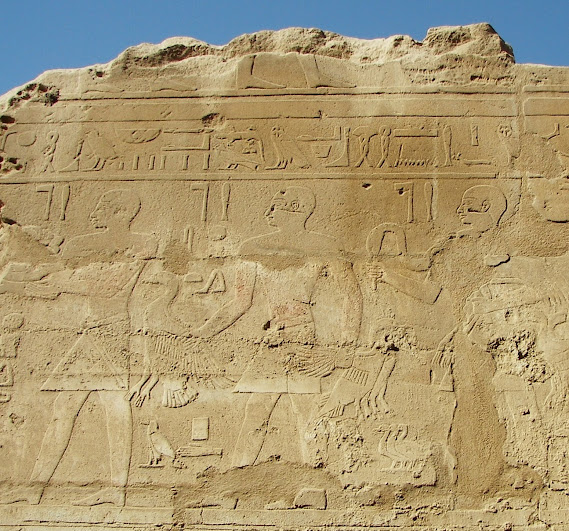
One thing we must immediately think of when we contemplate such questions is the people. There must have been people doing things in these major structures! And indeed, there were, and more than a few of them. Priests and priestesses, servants, caretakers. High clergy, low clergy, and auxiliaries (fig. 1). An equally enormous workforce was needed to keep the gigantic cosmic machinery that these temples were ticking over.


Fig. Priests at Karnak carrying offerings


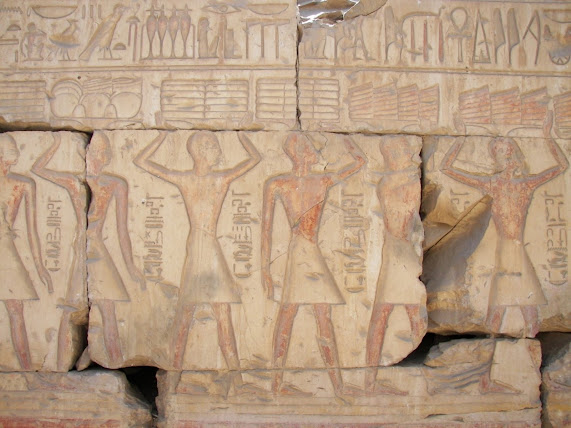
You see, other than in most current religions, where temple, church, and mosque are gathering places for people to congregate and celebrate their faith together, the temples of ancient Egypt had no such purpose. The temples of ancient Egypt were, quite literally, the houses of the gods, their homes. The essence of the gods dwelled in the temples, and it was that presence that the priesthood and every other person allowed to set foot inside the hallowed walls were meant to serve. Nowadays, we translate their title as priest or prophet, but the real, simple translation of their name m nr was “servant of the god” (fig. 2).


Fig. 2: Priest of the Temple of Ramesses II at Abydos


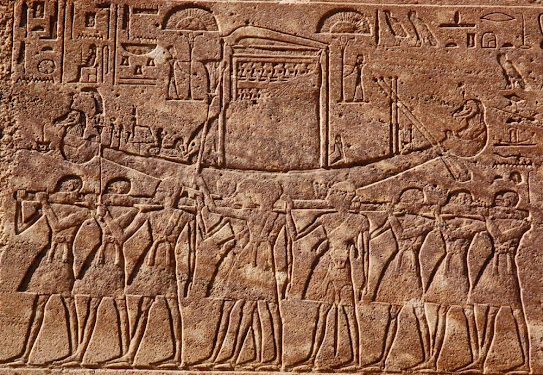
So we have a giant, vast mansion (or a smaller one) meant to be the dwelling place of a god or a group of gods, staffed with servants whose job description was to see to the divinity’s every need. A bit like Downton Abbey but then the one being served was a divinity in statue form. And seeing to their every need included waking them up in the morning, helping them wash, dress, put on makeup, jewellery and ointments, and so on—in a ritual that had thirty-six specific, core steps with their own “spells” or recitations for each step, with a possible twelve more depending on which temple. It included making sure they were fed with the essence of the best beef, fowl, bread, beer, fruits, and other good things the world had to offer. It included organising trips out into the world, grand processions for great feasts where the whole populace would come out to celebrate alongside the route (fig. 3). And it meant doing everything else that was needed to keep the temple, the worship, and keeping the essence of the god on earth and satisfied, going, with all that entailed. These servants of the god and their subordinates were in charge of all that, but those, somewhat more esoteric things were not even the only things that went on in the temples. There was also simpler, more practical work to do.


Fig. 3: Priests transporting the barque of Amun


In the middle of each temple precinct, there is a temple, made of stone. Big or small, the central building, the focus, the dwelling place of the god was always made of enduring stone after a certain time period. But there were usually also grounds and auxiliary buildings around it, and these were often made of mud brick, a much cheaper, but also more perishable material. So many activities took place there: school teaching the offspring of the priests, baking of bread, slaughter of offerings, making of offering bouquets of flowers, making of art and jewellery and much more—everything practical that needed to be done to produce the end result of keeping the god happy and in place (fig. 4). The day-to-day management of the assets of the god took place there—including scribal activity, accounting, overseeing the treasury, keeping track of taxes. There was a continuous buzz of activity. For instance, it is estimated that in the New Kingdom, the most important deity of the time, Amun of Karnak, owned around 1/3 of the whole country in estates that went to feed the huge, ever-hungry machinery of Karnak Temple, and that over 80,000 people worked for the temple and estates of Amun during the reign of Ramesses III! So we are not talking just sleepy village chapels and priests, we are also talking about giant, busy concerns who would at times rival the pharaoh in worldly power.


Fig. 4: Food for the gods in the Tempe of Ramesses II at Abydos


So much went on in the temple and its environs, it’s hard to encompass in one’s mind. All the above, and medical work, astronomy to know when the festivals should take place, architecture, and planning for the next embellishment of the mansion of the god, dealing with petitioners and the occasional oracle, the list goes on. And for all these, priests were needed. Many titles and specific functions have come down to us from those seemingly silent columns and walls, as well as papyri. And we still do not know everything, as the evidence is fragmentary and still being decoded.

We do know that the priesthood had levels and ranks, and that this was very important. There were the servants of the gods, who internally also had levels or classes, the wb or pure ones who seem to have been lower in rank, specialised priests such as stolists (dressers), lectors (readers), mortuary priests, horologues (hour-keepers), astronomers, and auxiliary personnel who may or may not have also been seen as priests (fig. 5). Then there were other priests of very specific titles where it is also mentioned what rank they had. There were the ‘pure ones of Sekhmet’ and the ‘scorpion charmers’ for instance, in whose job descriptions it is specifically mentioned that they had the same rank as the high priest, or the ‘first servant of the god’.


Fig. 5: Specialist priests (W867)


Try to picture this next time you visit an ancient Egyptian temple—you can try and look through the veil of time, from the majestic silent sentinels that remain, to the vibrant hub of activity it must have been in its heyday.

Monday, 24 January 2022

An Introduction to the Priests and Priestesses of Ancient Egypt

The blog post for this week is written by Yvonne Buskens-Frenken, from the Netherlands. She is a member of the Dutch Egyptology society Mehen and a former student of Egyptology at Manchester University (Certificate 2015 and Diploma 2017). While Yvonne has never been to the Egypt Centre before, she hopes to visit in the near future, perhaps with other Mehen members.


Introduction

Last week a new online course was launched by the Egypt Centre called In the Service of the Gods: Priests and Priestesses in Ancient Egypt, again brilliantly hosted by Dr Ken Griffin. Over the course of five weeks, the roles of priests, the priesthood of Amun, the God’s Wife of Amun, and that of Priestesses will be discussed. When starting a new course, I always ask myself what do I know about the topic and, for that matter, what I don’t. What new things will there be to learn this week? Already in this first week, I was pleasantly surprised with a newly published article that was brought to our attention; an article I will expand upon further below in this blog post. But first some sources on ancient Egyptian priests.


Sources
First of all, we do have Egyptia
n texts in the form of temple inscriptions, statue inscriptions, and papyri, such as the Abusir Papyri (fig. 1). The Abusir Papyri are a series of Fifth Dynasty administrative documents that give us detailed information on topics like the duty rosters for priests and how a royal mortuary temple should be run (Posener-Kriéger & de Cenival 1968). It further provides an overview about inventories of temple equipment and a list of daily offerings. They also concerned the two solar temples at Abu Gurab. Additionally, we have texts from classical authors like Herodotus, Diodorus, and Strabo. Herodotus (II, 36) describes, for example, the daily lives of priests, their cleansing rituals, religious duties, and eating habits (rules). But the majority of the textual evidence derives from the Graeco-Roman Period.

Fig. 1: Abusir Papyri. BM EA EA10735,10 (© The British Museum)


Article: Was the King of Egypt the Sole Qualified Priest of the Gods?
Dr Griffin introduced a recently published article, written by John Baines asking the question of whether the king was the sole qualified priest of the gods (Baines 2021). The contents of the article are certainly food for thought: are we perhaps mislead by images of kings in temple rituals, by texts from (classic) authors and the available objects about the topic? In his article, the author comes to the conclusion that the notion of the pharaoh being its sole fully legitimate priest is actually a modern one. The king rarely has priestly titles when carrying out rituals before the gods in temples and these activities do not signify that the king is a priest at all. In a scene depicted in the Great Hypostyle Hall at Karnak (fig. 2), you see the barque of Amun carried by numerous semi-divine figures (called the Souls of Nekhen and Pe). In the middle is a figure of the king (originally Seti I, but later usurped by Ramesses II) dressed as a priest. In this case, the king is actually identified as the High Priest, but this is a rarity according to Baines. Sometimes the king and priests are shown in the same scenes, but here the king is, as Baines states, rather playing the role of a priest in a liminal or divine world than acting as a priest.


Fig. 2: Ramesses II at the High Priest of Amun (after Baines 2021, fig. 6)


There are, of course, some well-known examples showing a king being depicted as a priest; the best-known examples are the ones from Ay in the tomb of Tutankhamun and of Herihor in the temple of Khonsu at Karnak. The one depicting Ay is actually unique and has its focus probably more on another aspect; the legitimisation of Ay as the successor of Tutankhamun rather than his role as an actual priest (fig. 3).

Fig. 3: Ay performing the Opening of the Mouth ceremony of Tutankhamun


Daily Temple Rituals
The Daily Temple Ritual consists of thirty-six core rituals, which are occasionally supplemented by additional acts. These cultic rituals were performed for the statue of the god by temple priests each day. They were mostly performed in the early morning and the High Priest was responsible for undertaking these rituals. The Daily Temple Rituals are attested in the temple of Seti I in Abydos, Medinet Habu, and the Great Hypostyle Hall at Karnak. They are also described in Papyrus Cairo CGC 58030 + Turin CGT 54041, and Papyrus Chester Beatty IX (Tacke 2013). John Baines refers to these rituals in his article, focussing specifically on the Abydos reliefs. According to him, the ritual spells explicitly concern priestly performances, which are adapted from models designed for priests (fig. 4). The king performing these rituals, for example, is not depicted as a priest and is also not captioned as one. Details of the design and captioning in these compositions are non-standard and cannot be taken as normal presentations of the king.


Fig. 4L Seti I burning incense before Osiris and Wepwawet


How to become a priest and priests appointed by the king
In ancient Egypt you could become a priest by:
• Hereditary right (from father to son);
• Ballot (a popular way);
• You could also buy your way in though purchasing the office (mainly during the Greek Period);
• Royal appointment, like Khaemwaset, son of Ramesses II.
Baines notes that in the running formula at Abydos, the text reads: “It is the king who has commanded to me to see the god” (n nswt wḏ n.i͗ mꜣꜣ nṯr). This is remarkably similar to the papyrus version (Papyrus Berlin 3055, iv, 2–3), which reads: “Now I am a priest; it is the king who has despatched me to see the god” (i͗w ḥm i͗nk ḥm-nṯr i͗n nswt wḏ wi͗ r mꜣꜣ nṯr). However, such texts are extremely rare in temple inscriptions.


Pasherienimhotep
Every week during the course, items from the Egypt Centre collection related to priests and priestesses will be highlighted. This week it is the beautiful stela of Pasherienimhotep (W1041) who was a priest of Edfu (fig. 5). In the text we find a comprehensive selection of priestly titles like Scribe of the Troops, Second Scribe of the Temple, God’s Servant of Harpakhered, God’s Servant of Amun of the Storehouse, Overseer of the Wab-priests of Sekhmet, Overseer of Magicians of Serqet, Chief Lector Priest, Scribe of the Divine Book, and Overseer of the Priests of Horus of Edfu.

Fig. 5: Front face of the stela of Pasherienimhotep (W1041)


Although Pasherienimhotep is not known from other sources, we do know from this stela that his father was the Third Priest of Horus of Edfu, called Harsiese. Interesting fact is that an owner of a stela now in the Cairo Museum (CGC 22049) bears the same name and priestly title as the father of Pasherienimhotep. The Harsiese of the Cairo stela mentions his parents. If this Harsiese is Pasherienimhotep’s father, a possible family tree can be proposed for Pasherienimhotep (fig. 6)!

Fig. 6: Proposed family tree of Pasherienimhotep


Week 2 of the course will be focused more on the role of priests.

Bibliography:

Baines, John 2021. Was the king of Egypt the sole qualified priest of the gods? In Collombert, Philippe, Laurent Coulon, Ivan Guermeur, and Christophe Thiers (eds), Questionner le sphinx: mélanges offerts à Christiane Zivie-Coche 1, 73–97. Cairo: Institut français d’archéologie orientale.

Escolano-Poveda, Marina 2020. The Egyptian priests of the Graeco-Roman period: an analysis on the basis of the Egyptian and Graeco-Roman literary and paraliterary sources. Studien zur spätägyptischen Religion 29. Wiesbaden: Harrassowitz.

Posener-Kriéger, Paule and Jean Louis de Cenival 1968. The Abu Sir papyri. Hieratic Papyri in the British Museum 5. London: The Trustees of the British Museum.

Sauneron, Serge 2000. The priests of ancient Egypt, New ed. Translated by David Lorton. Ithaca (NY): Cornell University Press.

Tacke, Nikolaus 2013. Das Opferritual des ägyptischen Neuen Reiches, 2 vols. Orientalia Lovaniensia Analecta 222. Leuven; Paris; Walpole, MA: Peeters.

Monday, 17 January 2022

The Egypt Exploration Society Congress VI: Call for Papers

2022 will see many events and exhibitions to commemorate two important Egyptological anniversaries. The first is the bicentenary of the announcement by Jean-François Champollion that he had cracked the code of Egyptian hieroglyphs with the partial decipherment of the Rosetta Stone. To mark this event, the British Museum will be hosting a conference and exhibition entitled Unlocking Ancient Egypt. The second is the centenary of the discovery of the tomb of Tutankhamun in the Valley of the Kings, which was led by Howard Carter. This is arguably the greatest archaeological discovery ever made, with all of the treasures from the tomb to be displayed in the new Grand Egyptian Museum (GEM) scheduled to open later this year.


Fig. 1: View of Singleton Campus, Swansea University

Another event taking place this year is the Egypt Exploration Society Congress (formerly the British Egyptology Congress, BEC). This will be the sixth congress, with the previous one being hosted via Zoom by colleagues from Durham University. This year, the Congress will be organised by colleagues and students from the Egypt Centre, the Department of History, Heritage, and Classics, and the Object and Landscape Centred Approaches to the Past (OLCAP) research group, in collaboration with the EES. Because of the on-going COVID-19 situation, the majority of the event will take place virtually, spread out throughout the month of September. However, we are hoping that it will be possible to have one or two in-person days (to be streamed online also) in Swansea during the weekend of the 01–02 October. The call for papers is now open, with details in the paragraphs below.


EESCon provides a platform for researchers to present their ongoing projects and discoveries to a broad audience of peers and the interested public through presentations or posters.


Presentations can focus on a wide range of topics including but not limited to:

  • Archaeology and current fieldwork
  • Language and texts
  • Art and craft
  • Trade and communication
  • Conservation
  • Medicine
  • Reception
  • The history of Egyptology and collecting
  • Museum or archive studies
  • Religion
  • Material culture
  • Heritage engagement and management
  • Environmental studies
  • Domestic archaeology
  • Object-based learning
  • Best practice in Egyptological teaching

Papers can cover any period of Egyptian history as well as the impact of Egyptian heritage on the modern world and can be given by anyone involved in current research. Time will be available for presenting the posters online.


Abstracts for a 20-minute presentation should be submitted by 17:00 on 25th February 2022 to congress@ees.ac.uk. They should not exceed 150 words. Presentations should be given in English and presenters should expect questions following their paper. Poster presenters must follow the template provided (A1, landscape). They will be made available on the Congress website as a downloadable pdf alongside the abstract. Abstracts not exceeding 150 words are to be submitted to congress@ees.ac.uk by 17:00 on 25th February 2022.


Abstracts will be considered by a panel made up of representatives from the organising institutions and confirmation will be mailed by 29th April 2022. Conference registration will open on 6th May 2022. Please indicate on your submission whether you prefer to present in-person or online.


We look forward to receiving your submissions for the Congress!

Monday, 10 January 2022

More Than Just a Load of Old Stones?

Robert de Rustafjaell (1859–1943) was one of the most interesting and enigmatic collectors of the early twentieth century. His collections were dispersed in five sales: Sotheby’s, 19–21 Dec 1906 (550 lots), 9–10 Dec 1907 (245 lots), 20–24 Jan 1913 (1051 lots), Paris 29 May 1914, and New York 29 Nov–1 Dec 1915 (745 lots). The first sale produced £1,843, the second £308-12, the third £2,748, and the fifth $12,760. A posthumous sale took place in New York 13–14 Dec 1949. According to Hagen and Ryholt (2014, 160, 162, 259), Rustafjaell would issue press releases about important discoveries, all of which were related to objects in his own collection, which had, rather conveniently, just appeared at auction. The ultimate aim was to drive up the price by creating a bidding war! Objects from these sales have since ended up in the British Museum, British Library, Berlin Museum, the Louvre, and many other museums. During the first two sales in 1906 and 1907, Sir Henry Wellcome bought extensively, with at least 500 objects from these sales now in the Egypt Centre collection. Perhaps the most unusual of all these objects are eleven stones, which will be the focus of this blog (fig. 1). But what are they, and are they more than just a load of old stones?

Fig. 1: EC1432g


EC1432a–k are eleven fairly large and irregularly shaped stones, all of which have a hollow. Some bear their lot stickers of 204/6 or 206/7, indicating that they were purchased by Wellcome during the 1907 Rustafjaell sale. The auction catalogue describes both as “a similar lot”. However, they are preceded by the following text: “WATER RECEPTACLES IN LIMESTONE AND FLINT, used in the fabrication of Flint Implements in the palaeolithic period. [Plate II]. A description of these very interesting vessels and an account of their discovery on the plateau of the Desert, W. of Thebes, has recently been published by Mr. Rt. De Rustafjaell, “Palaeolithic Vessels of Egypt: The earliest handiwork of Man” (Macmillan & Co.). The evidence of the use of such vessels in the manufacture of flint instruments is shown by the wall painting (of a very much later period) discovered at Beni Hassan. The receptacles seem to have been selected from stones having a natural hollow on one surface: they were then roughly fashioned into shape and the hollow artificially enlarged. Unfortunately most of the distinct evidence of this artificial enlargement has disappeared, partly by the accidental abrasion arising from long-continued use, and mostly by the weathering to which the objects have been subjected since the very remote period of their production.” (fig. 2)

Fig. 2: Plate II of the 1907 catalogue showing two "vessels" on the top row and two on the bottom


As noted in the description, these “vessels” were published by Rustafjaell shortly before the auction took place. Rustafjaell describes exploring the Western Desert in the Theban region during the first half of 1907. The largest of the “vessels” were found near the area of el-Mallah, halfway between Luxor and Nagada on the West Bank of the Nile (Rustafjaell 1907, fig. 1). He notes that “this site was undoubtedly then a ‘factory’ of limestone water vessels, and the halting pace in the valley below, where we took shelter, probably served as the distributing centre for this kind of ware (fig. 3). It is probable that these vessels were hewn out with Palaeolithic flint implements, and indeed two axeheads were found near the cluster” (Rustafjaell 1907, 18). Additionally, “the cavities thus produced by natural means would hold water readily, and it was no doubt the sight of these natural vessels that first prompted the palaeolithic man to an artificial adaption with the same purpose in view” (de Rustafjaell 1907, 14).

Fig. 3: De Rustafjaell 1909, Plate XII

Are these objects really early receptacles for liquids and the inspiration for later stone vessels, as proposed by Rustafjaell? Well, not quite. These objects are nothing more than natural stones (fig. 4)! But did Rustafjaell really think that they were ancient “vessels” or was this a ruse to making some money out of nothing? Lots 202–208 are all described as similar objects, which amounted to forty-eight items. If Rustafjaell really was trying to cash in on his “discovery”, he would no doubt have been disappointed as these five lots for very little money. Wellcome, possibly disappointed with the purchases his agents made during the 1907 sale—aside from the lots described above, a high percentage of those purchased were fakes—bought very few lots during the 1913 sale.

Fig. 4: The Illustrated London New article announcing the discovery


Perhaps quite appropriately, Rustafjaell (1907, 22) finishes his booklet with the following words: “Time alone can turn conjecture into certainty and future generations may have exact knowledge where we can only form theories”.

Bibliography:

De Rustafjaell, Robert 1907. Palaeolithic vessels of Egypt: or the earliest handiwork of man. London: Macmillan.

———. 1909. The light of Egypt: from recently discovered predynastic and early Christian records. London: Kegan Paul, Trench, Trübner.

———. 1914. The stone age in Egypt; a record of recently discovered implements and products of handicraft of the archaic Nilotic races inhabiting the Thebaid. New York: W. E. Rudge.

Hagen, Fredrik and Kim Ryholt 2016. The antiquities trade in Egypt 1880–1930: the H.O. Lange papers. Scientia Danica. Series H, Humanistica, 4 8. Copenhagen: Det Kongelige Danske Videnskabernes Selskab.

Sotheby, Wilkinson & Hodge 1906. Catalogue of the collection of Egyptian antiquities, formed in Egypt by R. De Rustafjaell, which will be sold by auction by Messrs. Sotheby, Wilkinson and Hodge...19th December, 1906 and two following days... London: Sotheby, Wilkinson & Hodge.

———. 1907. Catalogue of a collection of antiquities from Egypt, ... being the second portion of the collection of Robert de Rustafjaell, esq. F.R.G.S, which will be sold by auction, ... on Monday, the 9th of December, 1907, and the following day. London: Sotheby, Wilkinson & Hodge.

———. 1913. Catalogue of the remaining part of the valuable collection of Egyptian antiquities formed by Robert de Rustafjaell, Esq. London: Sotheby, Wilkinson & Hodge.

Monday, 3 January 2022

A Review of 2021 at the Egypt Centre

As with 2020, this past year has been one with many challenges due to the COVID-19 Pandemic. Throughout this time, staff at the Egypt Centre have been working extra hard with our public engagement, both in person and online. In doing so, we have been able to make 2021 a success on many fronts. This blog post will present a brief review of some of the yearly highlights.

Perhaps the most important development of 2021 was the reopening of the museum to visitors after sixteen months of closure due to the Pandemic. This was a moment staff and volunteers had been waiting for what seemed like an eternity. Preparation for the reopening started in July to make the museum “COVID safe”. This was followed by four weeks of workshops for small groups of children in order to trial the new regulations. The museum finally opened the public and for schools in early October, albeit with reduced numbers and opening times. School groups now regularly visit the museum three times a week, while students also have the opportunity to work directly with the collection in-person once again (fig. 1).

Fig. 1: Object-focused learning retuns to the Egypt Centre


2021 was a special year for the Egypt Centre as we celebrated fifty years since a large portion of the Wellcome collection arrived in Swansea, a collection that forms the core of the museum. To mark this occasion, we hosted a successful three-day conference. This event brought together curators and researchers from across the UK who work directly with Wellcome’s Egyptian collection. One of the highlights of the event was the announcement that the UCL Culture Heritage and Museums committee had agreed to transfer the plaster cast of the statue of Djedhor the Saviour to Swansea to be reunited with the base (fig. 2). The transfer of the statue is expected to take place in the summer of 2022. We are grateful to the committee, and especially to Anna Garnett, for making this happen.

Fig. 2: Plaster cast of the Djedhor the Saviour statue on display in the old Wellcome Museum


Coinciding with the anniversary conference was the launch of the new Egypt and its Neighbours display. Thanks to funding from the Institute of Classical Studies, Ersin Hussein and I selected objects from Greece, Rome, Cyprus, the Near East, and Nubia, many of which had never been displayed before (fig. 3). The case has been well received by visitors, with the cast of a statue of Lamassu—a celestial being from ancient Mesopotamian religion bearing a human head, bull’s body, sometimes with the horns and the ears of a bull, and wings—a particular favourite with school children. With the museum being closed for the first half of 2021, this also provided the opportunity to refurbish some of the other cases. For example, the Amarna objects were moved to a larger case, which allowed for more objects to be displayed.

Fig. 3: The new Egypt and its Neighbours case


From February 2021, the Egypt Centre collaborated with the newly formed Interdisciplinary Egyptology (IntEg) group to host twelve discussion panels via Zoom. One of the aims of the group is to present cutting-edge interdisciplinary discussions in the field of Egyptology. Over six weeks in February and March 2021, twelve discussion panels took place. Topics included archaeology, Egyptology in the digital age, ethics, and Egyptology’s post-colonial future (fig. 4). While these events were not organised by the Egypt Centre, they helped to increase the international awareness of the museum.

Fig. 4: Stats from the IntEg panel discussions


In November, Egypt Centre volunteer and former Swansea University student, Sam Powell, was awarded the prestigious Welsh Regional Marsh Award for Museum Learning in a ceremony held at the British Museum (fig. 5). During the Pandemic, Sam moderated online Egyptology courses, fundraising events and conferences, created and hosted online quizzes, as well as writing blogposts. Her creation of the Egypt Centre’s online catalogue (Abaset) has helped to make the collection much more accessible to researchers and the public. In addition, Sam’s research on Egypt Centre objects, specifically wooden ancient Egyptian figures, has broadened the knowledge of these items. This was a thoroughly deserved award and we are very grateful for all the work that Sam has done for the Egypt Centre.

Fig. 5: Sam receiving her volunteer of the year award


While the above highlights are just a few of the many successes of 2021, we look forward to more in 2022. In a few weeks, I’ll be starting my latest Egypt Centre course, which examines priests and priestesses in ancient Egypt. We plan to continue refurbishing the galleries, including installing a new Writing and Maths case in the House of Life. And don’t forget that in September the Egypt Centre is teaming up with the Egypt Exploration Society to host the EES Congress. All in all, plenty to look forward to in 2022. Happy New Year from all of us at the Egypt Centre!